ACADEMY
The Blog

Real AI playbooks, not repackaged theory

Written from the same client work the courses are built from. No fabricated case studies, no invented statistics.
How Often You Need to Update Content to Stay Cited by AI Search

A 47,000-citation study found 75% of AI-cited pages were updated within the past year, but the cadence differs sharply by engine. Here's what actually predicts freshness, and how to set an update schedule instead of guessing.

Read the post

How to Stop Your n8n AI Agent Workflow From Blowing Through Your API Budget

An AI Agent node that loops, retries, and fires concurrently can turn a $20 test run into a $2,000 bill overnight. Here's the concurrency, rate-limit, and model-routing guardrails that actually stop it, plus where a free self-hosted model does the job for nothing.

Read the post

Should You Flatten Your Org Chart With AI? What Meta's Reversal and the Real Span-of-Control Data Show

Gartner predicts 20% of companies will use AI to eliminate half their middle-management roles by 2026. Meta tried spans of 50+ direct reports per AI-assisted manager, then reversed course. Here's what the data actually says about how wide a manager's span of control can go.

Read the post

Open WebUI vs LibreChat vs AnythingLLM: Which Self-Hosted AI Chat Interface Actually Fits Your Team

Three free, open-source alternatives to ChatGPT Business all claim to be the self-hosted answer. Here's how their RAG, multi-user, and multi-provider architectures actually differ, and which one fits your team's real bottleneck.

Read the post

How to Learn AI Product Development: From RAG Tutorial to Shipped Product

Most "learn RAG" tutorials teach you to recite chunking, embeddings, and retrieval without ever seeing the pipeline break. Here is the free path to actually understand it, and where tutorials stop being enough.

Read the post

AI Agent Guardrails: How to Build Real Human-in-the-Loop Oversight Before Something Breaks

Agentic AI adoption is projected to hit 74% of enterprises within two years, but only 21% have a mature governance model today. Here's how autonomous agents actually work, and a practical human-in-the-loop framework founders can put in place this week.

Read the post

How to Track AI Search Traffic: GA4's AI Assistant Channel vs. What Your Server Logs Actually Show

GA4 shipped a native AI Assistant channel in 2026, but it misses Perplexity and up to 70% of AI referral sessions land in Direct anyway. Here's what it actually measures, where it breaks, and how server logs and crawl data fill the rest.

Read the post

Multi-Agent Orchestration in n8n: The Orchestrator-Worker Pattern Explained

A single AI Agent node with fifteen tools gets slower and less reliable as you add capability, not more capable. Here is how n8n's AI Agent Tool and Call n8n Workflow Tool nodes let you split that into an orchestrator and specialized workers, and the real data on why it works.

Read the post

Open-Source Embedding Models vs OpenAI: BGE-M3, Qwen3-Embedding, Nomic, and When Self-Hosting Actually Pays Off

OpenAI's text-embedding-3 models are the default pick for most RAG pipelines, but open-weight models like BGE-M3 and Qwen3-Embedding now beat them on MTEB and cost a fraction as much to run at real volume. Here's how to actually decide.

Read the post

Do You Need a Chief AI Officer? A Founder's Framework for Fractional vs Full-Time vs DIY

Chief AI Officer adoption nearly tripled in a year, but that doesn't mean every founder needs a hire. Here's how to decide between fractional, full-time, and doing it yourself.

Read the post

Who Should Own GEO? What a 2026 Survey of 150 B2B Marketers Reveals

A 2026 report on 150 B2B tech marketers found no department owns generative engine optimization, and 51% blame a real skills gap, not the org chart. Here is what the data says actually separates teams that get cited from teams that don’t.

Read the post

How to Evaluate a RAG Pipeline: Recall@k, MRR, and Ragas Metrics Explained

Recall@k and MRR tell you whether your retriever found the right chunk. Ragas' faithfulness and context precision tell you whether the generator actually used it correctly. Here's how each metric works, and a 2024 SIGIR paper's evidence that retrieval scores alone don't predict downstream RAG quality.

Read the post

Free n8n Course vs Paid AI Automation Course: What Actually Gets You to Production

n8n's docs and free tutorials teach the agent-building basics for nothing. Here's exactly what they leave out, and where a structured course earns its cost.

Read the post

n8n Error Handling for AI Agent Workflows: Retry Logic, Error Triggers, and the Pattern That Actually Survives Production

Most n8n AI agent workflows only get Retry On Fail turned on, then fail silently the first time something a retry cannot fix goes wrong. Here is the three-layer error handling architecture, and the retry-quarantine-escalate pattern, that actually holds up.

Read the post

Brand Mentions Beat Backlinks for AI Citations — But Mostly on Google, Not ChatGPT

Ahrefs studied 75,000 brands and found unlinked web mentions correlate with AI Overview visibility three times more strongly than backlinks. A second study shows why that only holds on Google.

Read the post

How to Build an AI Tool Approval Process Before Shadow AI Builds One for You

The average organization now runs 15 generative-AI apps, and more than half were never approved. Here's the four-check intake workflow that gets a fast yes without becoming the reason people go around it.

Read the post

n8n Queue Mode Explained: How to Scale AI Agent Workflows Without Losing Executions

Regular-mode n8n runs triggers and workflows in the same process, which is exactly what breaks first once AI Agent nodes are involved. Here is what queue mode actually changes, why Postgres and Redis are non-negotiable, and two genuinely open-source alternatives if the fair-code license is the real blocker.

Read the post

Claude Skills vs MCP vs Subagents: What Each One Actually Does

Skills, MCP, and subagents get treated as competing options, but they solve three different problems: knowledge, action, and isolation. Here's the mechanism behind each one and how real setups stack all three.

Read the post

Does llms.txt Actually Get You Cited by AI? What Two 2026 Studies Found

Two 2026 studies tracked llms.txt across more than 400,000 domains combined. Neither found a link to AI citations, and the server logs show why.

Read the post

Why AI Agents Get Dumber the Longer They Run: Context Rot and Context Engineering Explained

Context rot is a measured property of how LLM attention degrades over long inputs, not a weaker model. Here's what Chroma's and Anthropic's own research shows, and the compaction, retrieval, and compression techniques that actually fix it.

Read the post

Why AI Rollouts Fail at the Middle-Manager Layer (And How Founders Fix It)

New HBR and Microsoft research shows AI rollouts don't stall with leadership or individual contributors — they stall with the managers stuck validating everyone else's AI output. Here's what actually fixes it.

Read the post

n8n's MCP Server Trigger: How to Turn Any Workflow into a Tool Claude Can Call

n8n ships two completely different things called "MCP." Here's how the native MCP Server Trigger node actually works, and how to wire a real workflow so Claude can call it at runtime.

Read the post

Free Alternatives to Cursor: How Cline, Aider, OpenHands, and Continue.dev Actually Differ

Cursor and GitHub Copilot cost $20-39/month per seat, but four mature open-source coding agents do the same job for free. Here is what each one actually does differently.

Read the post

How AI Browser Agents Actually See the Screen: Vision-Based Computer Use vs. DOM-Based Automation

Every AI browser agent runs the same observe-decide-act loop, but whether it reads pixels or the accessibility tree changes its cost, speed and reliability. Here's the mechanism, the real token math, and the open-source alternatives.

Read the post

Why Ranking #1 on Google Still Decides Who ChatGPT Cites

New AirOps data on 548,534 retrieved pages shows ChatGPT cites only 15% of what it retrieves, and Google's #1 ranking spot is still the single biggest predictor of which 15%.

Read the post

The AI Super-User Divide: Why 87% of Leaders See 5x Productivity Gains but Only 29% See ROI

A 2026 survey of 2,400 employees and C-suite leaders found AI "super-users" are 5x more productive, but most companies still can't show ROI from AI. Here's the actual mechanism behind that gap and what closes it.

Read the post

Prompt Caching Explained: How Claude, OpenAI, and Gemini Actually Cut Your LLM API Costs

Prompt caching can cut LLM input costs by up to 90%, but Claude, OpenAI, and Gemini implement it three different ways, and getting the breakpoint or TTL wrong means you pay a write premium for a cache you never read from.

Read the post

Pinecone vs Weaviate vs Qdrant vs pgvector: Which Vector Database Actually Fits Your RAG Stack

Vector database picks get made in week one and get expensive to reverse. Here's how ANN search actually works, and a real decision framework for pgvector, Qdrant, Weaviate, and Pinecone.

Read the post

LangGraph vs CrewAI vs AutoGen: How to Actually Pick an AI Agent Framework in 2026

AutoGen is now officially in maintenance mode, CrewAI just passed LangGraph in GitHub stars, and Microsoft shipped an entirely new successor framework. Here is how the three actually differ under the hood, and how to pick without building on something already past its shelf life.

Read the post

Mem0 vs Zep vs Letta: How AI Agent Memory Actually Works

Context windows aren't storage. Here's how Mem0, Zep, and Letta give agents real persistent memory, and why you shouldn't trust either vendor's benchmark claim at face value.

Read the post

What Is MCP (Model Context Protocol) and How AI Agents Actually Use It

OpenAI and Google adopted Anthropic's open protocol within five months of launch. Here's how MCP actually connects AI agents to your tools, and the tool-poisoning risk most getting-started guides skip.

Read the post

Shadow AI at Work: What Founders Should Actually Do About Unauthorized AI Tools

66% of employees have used AI tools at work they believed violated company policy, and 88% have pasted work data into public models. Here's what the 2026 survey data says actually stops it.

Read the post

AI Course Refund and Preview Policy: What to Actually Look For Before You Pay

Repackaged YouTube content with a price tag, or a real curriculum worth paying for? A practical checklist for vetting any AI course before you pay, and exactly what AIBOOTSTRAPPER Academy actually offers.

Read the post

Schema Markup Won't Get You Cited by AI: What Ahrefs' 1,885-Page Study Found

Ahrefs tracked 1,885 pages that added JSON-LD schema against 4,000 control pages and found AI citations barely moved, and even declined on Google AI Overviews. Here's what the data says actually earns a citation.

Read the post

Evaluating AI Agents in Production: LLM-as-a-Judge, Its Biases, and the Open-Source Observability Stack

LLM-as-a-judge makes it possible to score every agent trace at scale, but the same research that popularized it also found frontier judges failing over 50% of adversarial bias tests. Here is how the mechanism works, where it breaks, and the open-source tools (Langfuse, Arize Phoenix) that make agent behavior visible enough to catch it.

Read the post

RAG vs Fine-Tuning: How to Actually Decide (Now That OpenAI Is Shutting Down Its Fine-Tuning API)

OpenAI is winding down its self-serve fine-tuning API on a fixed 2026-2027 timeline. Here's how retrieval and fine-tuning actually work under the hood, why naive RAG pipelines fail in production, and a real decision framework for which one your product needs.

Read the post

n8n vs Zapier vs Make for AI Agent Workflows: Why the Pricing Model Decides More Than the Feature List

Zapier bills per task, Make bills per operation, n8n bills per execution — and that difference barely matters until an AI agent starts looping. Here is the real cost math for agentic workflows.

Read the post

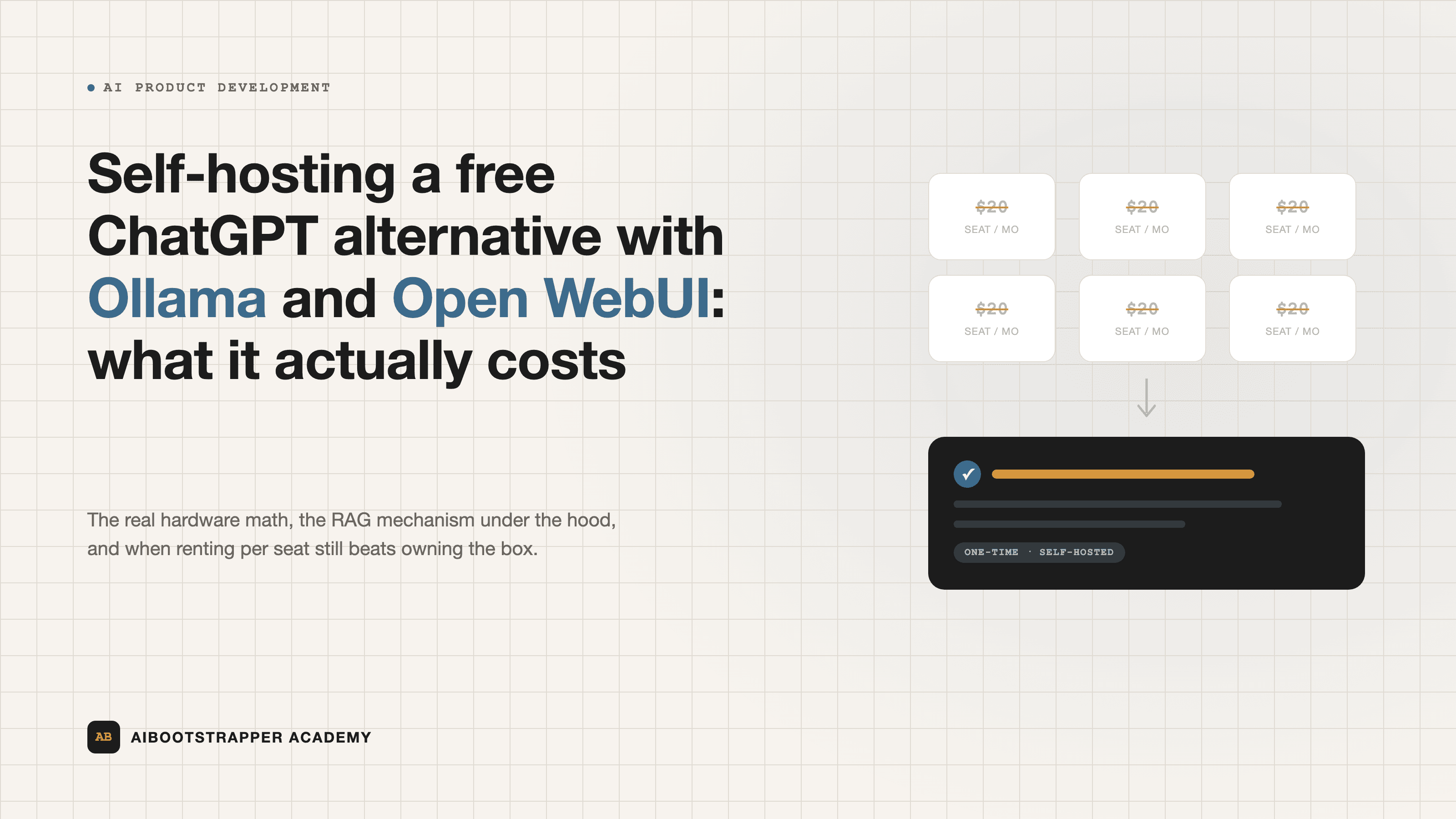
Self-Hosting a Free ChatGPT Alternative with Ollama and Open WebUI: What It Actually Costs

Ollama and Open WebUI let you run a ChatGPT-style assistant on your own hardware for free. Here's the real hardware math against ChatGPT Business pricing, how the built-in RAG actually works, and where the naive setup breaks.

Read the post
Why 95% of AI Pilots Fail to Show ROI (And How to Be in the 5%)

MIT's 2025 study of 300 enterprise AI deployments found 95% never move the P&L. Here's what the other 5% actually did differently, and what it means before you sign your next AI vendor contract.

Read the post
GEO vs SEO: What Actually Changes When AI Answers the Question Instead of Google

Search engine optimization got you ranked in a list of blue links. Generative engine optimization gets you cited inside the answer itself. Here is what that actually requires.

Read the post
How to Actually Automate a Business Process with AI Agents (Without Breaking Anything)

A practical framework for picking, building and shipping your first real AI automation, without the horror stories about agents that quietly went wrong.

Read the post
Courses launching soon

Want this as a full course, not just a post?

Join the waitlist and get a 20% launch discount the moment we open checkout. No payment now.

Taught by Aditya Jha · 40+ AI products shipped for real clients. No spam, unsubscribe any time.

Or join our free community for AI tips while you wait