Why AI Rollouts Fail at the Middle-Manager Layer (And How Founders Fix It)
New HBR and Microsoft research shows AI rollouts don't stall with leadership or individual contributors — they stall with the managers stuck validating everyone else's AI output. Here's what actually fixes it.
Most founders treat an AI rollout as an IT decision: pick the tools, write a usage policy, announce it in an all-hands, and watch productivity climb. A new Harvard Business Review study says that's exactly the plan that quietly breaks — not at the leadership level, and not among individual contributors, but in the layer between them.
Researchers Julia Shin and Sandra J. Sucher spent time inside two consulting firms, running 18 semi-structured interviews with partners, managers, and junior staff to see how each level actually used AI day to day. The pattern they found should worry any founder who thinks a rollout is "done" once the tools are purchased: senior leaders lean into AI's strategic upside, expanding scope and running leaner teams, while junior staff report real productivity gains. Middle managers get neither benefit. They absorb new work — validating AI output, catching errors, coaching their teams on tools nobody trained them to teach — on top of unchanged delivery pressure, with no formal support built into the rollout plan.
The Hidden Job Nobody Budgeted For
The specific new task eating manager time has a name now: workslop. Researchers at BetterUp Labs and Stanford's Social Media Lab coined it in a September 2025 HBR study to describe AI-generated work — a report, an email, a deck — that looks polished but lacks the substance to actually move a task forward. In a survey of 1,150 full-time US employees, 40% said they'd received workslop from a colleague in the past month. Someone has to catch it before it reaches a client or a board deck, and in most organizations that someone is the manager, because nobody else is positioned to.
This is the part that doesn't show up in an AI adoption dashboard. A tool-usage metric tells you how many people logged into Claude or ChatGPT this week. It says nothing about how many hours a manager spent quietly rewriting a subordinate's AI-assisted deliverable before it went out the door. That work is real, it's growing, and in most companies it's invisible because it was never named as a job requirement in the first place.
If you've read our piece on shadow AI at work, this is the flip side of the same problem: shadow AI is unauthorized tool use nobody's watching; workslop is authorized tool use nobody's checking. Both land on the same desk.
Why "Train the Managers Harder" Isn't the Fix
The instinctive founder response is to schedule more AI training for managers. Microsoft's 2026 Work Trend Index — a survey of 1,800 workers spanning 819 leaders, 520 managers, and 461 individual contributors — suggests that's not where the leverage is. The strongest predictor of whether a team actually gets value from AI isn't a training hour count. It's whether the manager visibly uses the tools themselves.
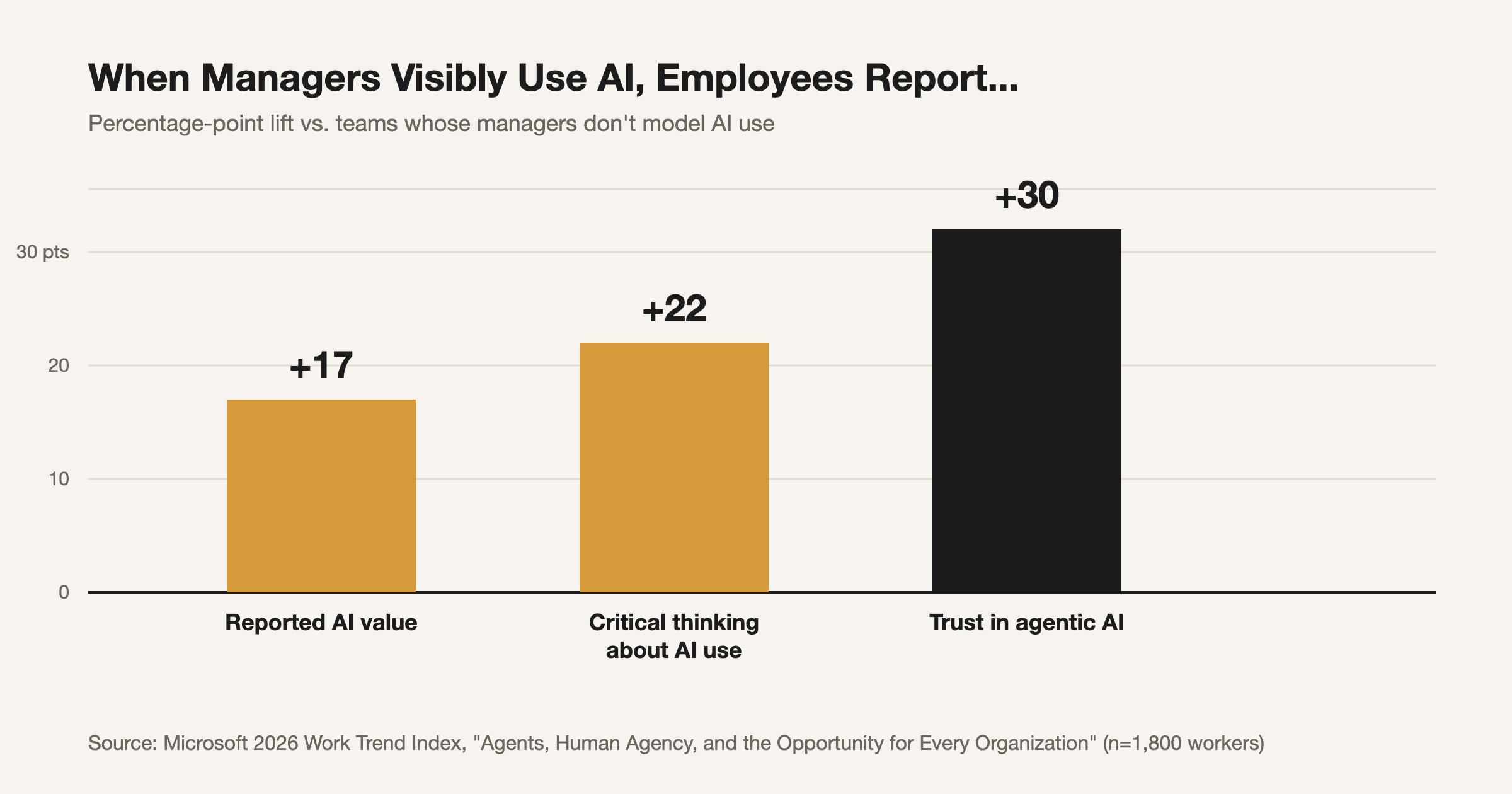
When a manager models AI use openly, their team reports a 17-point lift in the value they get from AI, a 22-point lift in critical thinking about when to trust or override an AI output, and a 30-point lift in trust in agentic tools specifically. Widen the lens further and the same report found organizational factors — culture, manager behavior, how experimentation is treated — account for 67% of the variance in AI impact, versus 32% for individual mindset. Manager behavior isn't one input among many; it's roughly two and a half times as strong a signal as anything an individual brings on their own.
That reframes the problem. A manager who's quietly drowning in workslop cleanup while being told to "encourage adoption" is being asked to model confidence in a system that, from where they sit, is currently generating extra work. You can't train your way out of that gap — you have to close it.
What Actually Closes the Gap
A few moves show up consistently across the research and in practitioner guidance on AI rollouts, and none of them require a bigger training budget:
- **Name the validation work as real work.** If managers are expected to review AI output before it ships, put a rough time allowance on it and take something else off their plate. An unnamed task is an invisible tax; a named one can be resourced.
- **Leadership goes first, visibly.** The Microsoft data is blunt about this: a rollout where the leadership team exempts itself from using the tools is already behind. If founders and execs aren't visibly using AI in their own work, don't expect managers to model it for their teams either.
- **Write down what AI isn't allowed to decide.** An approved tool list and a short policy on what data can go into them isn't bureaucracy — it's what lets a manager say "the model can draft this, but I'm not putting it in front of a client without a read" without second-guessing whether that's the "right" level of AI use.
- **Give managers a workslop checklist, not a vibe.** "Use good judgment" isn't a review process. A short, concrete rubric — does this cite a real source, does this match what the client actually asked, would I sign my name to this — turns an ambiguous judgment call into a two-minute check.
- **Protect the coaching time AI is displacing.** Shin and Sucher's research flags a longer-term risk: managers spending more hours checking AI output have less time for the mentoring that grows future leaders. If that time keeps getting eaten silently, you're not just slowing this quarter's rollout — you're thinning next year's leadership bench.
The Rollout Plan Most Founders Are Missing
None of this shows up in a tool-adoption percentage, which is exactly why it gets missed. If you've read our post on why 95% of AI pilots fail to show ROI, the middle-manager layer is one of the most common places that failure actually originates — not because the model is bad, but because the humans checking its work were never given the time, the rubric, or the visible top-down example to do it well. The AI super-user divide we've written about before shows the same pattern at the individual level: usage and value aren't the same thing, and the gap between them is filled by exactly the kind of organizational support most rollout plans skip.
If you're rolling out AI across a team right now, the honest audit isn't "how many people are using the tools." It's "what does my most conscientious manager's week actually look like," and whether the answer to that question is one you'd sign off on. Our AI Leadership for Founders course walks through the adoption playbook in more depth — including the decision-rights framework and rollout sequencing that keeps this exact bottleneck from forming in the first place.
Go deeper
AI Leadership for Founders
Want the full AI Leadership for Founders course, not just this post?
Join the waitlist and get a 20% launch discount the moment we open checkout. No payment now.
Taught by Aditya Jha · 40+ AI products shipped for real clients. No spam, unsubscribe any time.
Or join our free community for AI tips while you wait
One email a week: the AI tools, tactics, and course drops actually worth your time. No spam, unsubscribe anytime.
Questions about this or which course fits? Email academy@aibootstrapper.com and we'll answer it directly, not with a support ticket.