Why Your Website Rarely Gets Cited by AI Search — What a 102-Brand Study Found
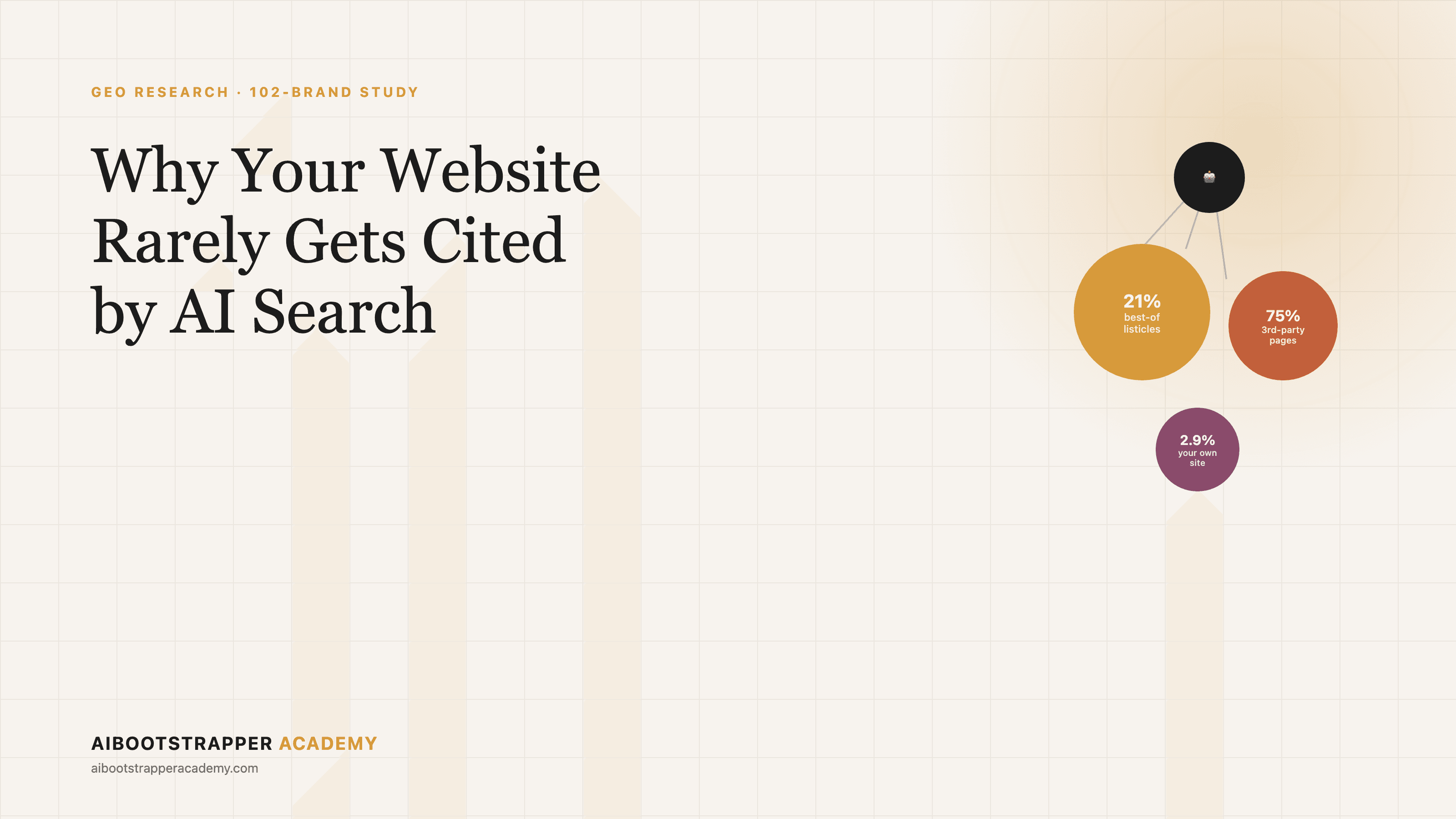
A 2026 study tracking 102 brands across 102,025 AI prompts found your own website earns just 2.9% of AI citations, while third-party comparison pages capture 75%. Here is what actually gets cited, and why small brands start furthest behind.
You've written a genuinely good comparison page, or a detailed product breakdown, published it on your own domain, done everything right by the SEO playbook you know. Then you ask ChatGPT or Perplexity the exact question that page answers, and your site isn't in the response. A competitor's page is, or worse, a listicle you've never heard of is. A June 2026 study tracking 102 real brands across five AI engines over three months has the actual numbers on why, and they explain a pattern a lot of founders have noticed but couldn't quite name: your own website is one of the least likely places an AI answer engine cites, no matter how good the page is.
What the study actually measured
The research, published by Pratyush Kumar of the AI-visibility tracking platform Ranqo, ran 3,508 tracking cycles across ChatGPT (GPT-5), Gemini 3, Perplexity (Sonar), Claude, and Grok between March and May 2026, generating 102,025 prompt responses and 15,815 tracked brand mentions. The core method used unbranded prompts, questions like "what's the best CRM for a 10-person sales team" that never name a company, across six categories: discovery, problem/solution, use case, comparison, expert opinion, and brand research. That's deliberate. A branded prompt ("tell me about Salesforce") tests whether an engine has indexed you at all, and nearly every real business clears that bar: branded recognition ran 94-100% across all five engines. The unbranded test is the one that actually matters for growth, because it measures whether the AI recommends you to someone who didn't already know your name.
Third-party pages win the citation, not you
Across all 132,124 URL citations Ranqo logged, 75.2% went to what the study classifies as corporate and third-party brand pages, meaning pages that write about a company without being that company's own site: comparison hubs, review platforms, marketplace listings, industry directories. Pages the brand itself owns and controls, its own homepage, product pages, and blog, accounted for 2.9% of citations, just 4,392 of the 132,124 total. The rest split across YouTube and video (4.2%), tech and business media (3.8%), Reddit and community forums (3.3%), Wikipedia (2.6%), and academic, government, and developer sources (3.1%).
This is the mechanical explanation for why writing a great page on your own domain doesn't reliably get you cited, and it lines up with a finding we've covered before: Google's #1 organic ranking spot is still the strongest single predictor of which sources ChatGPT actually cites, because most AI answer engines are running a live web search tool that retrieves and cites current pages before generating an answer, they aren't reasoning from a static memory of your site. When the query is a comparison or "best X for Y" question, a page structured to answer exactly that shape of question, gathering and ranking multiple options, is a stronger semantic match for the retrieval step than a single vendor's product page ever will be, even a well-optimized one. Your own site can absolutely earn a citation; it's just competing against a format built for the query, not just a company competing for a keyword.
The format that wins: comparison and "best-of" content
Broken down by content type, listicle-style pages, "10 Best X for Y" or "X vs Y vs Z" rankings, accounted for 21.0% of all citations in the study, more than any other single format. Generic articles followed at 18.3%, how-to guides at 5.7%, and video, direct comparison pages, and documentation combined for roughly 7% more.
| Content format | Share of all citations |
|---|---|
| "Best-of" listicles and rankings | 21.0% |
| Generic articles | 18.3% |
| How-to guides | 5.7% |
| Video, comparison pages, docs (combined) | ~7% |
That's a genuinely actionable split. It doesn't mean "get featured on a third-party listicle" is the only lever, our earlier coverage of Ahrefs' 75,000-brand mention study makes the same point from a different angle: independent, third-party text about your brand, not your own copy about yourself, is what a summarization model treats as evidence. It does mean that if your GEO plan is entirely "publish more content on our own blog," you're optimizing for the 2.9% slice of the pie while the format that wins the other three quarters barely appears on your roadmap.
The size tax: small brands start further behind
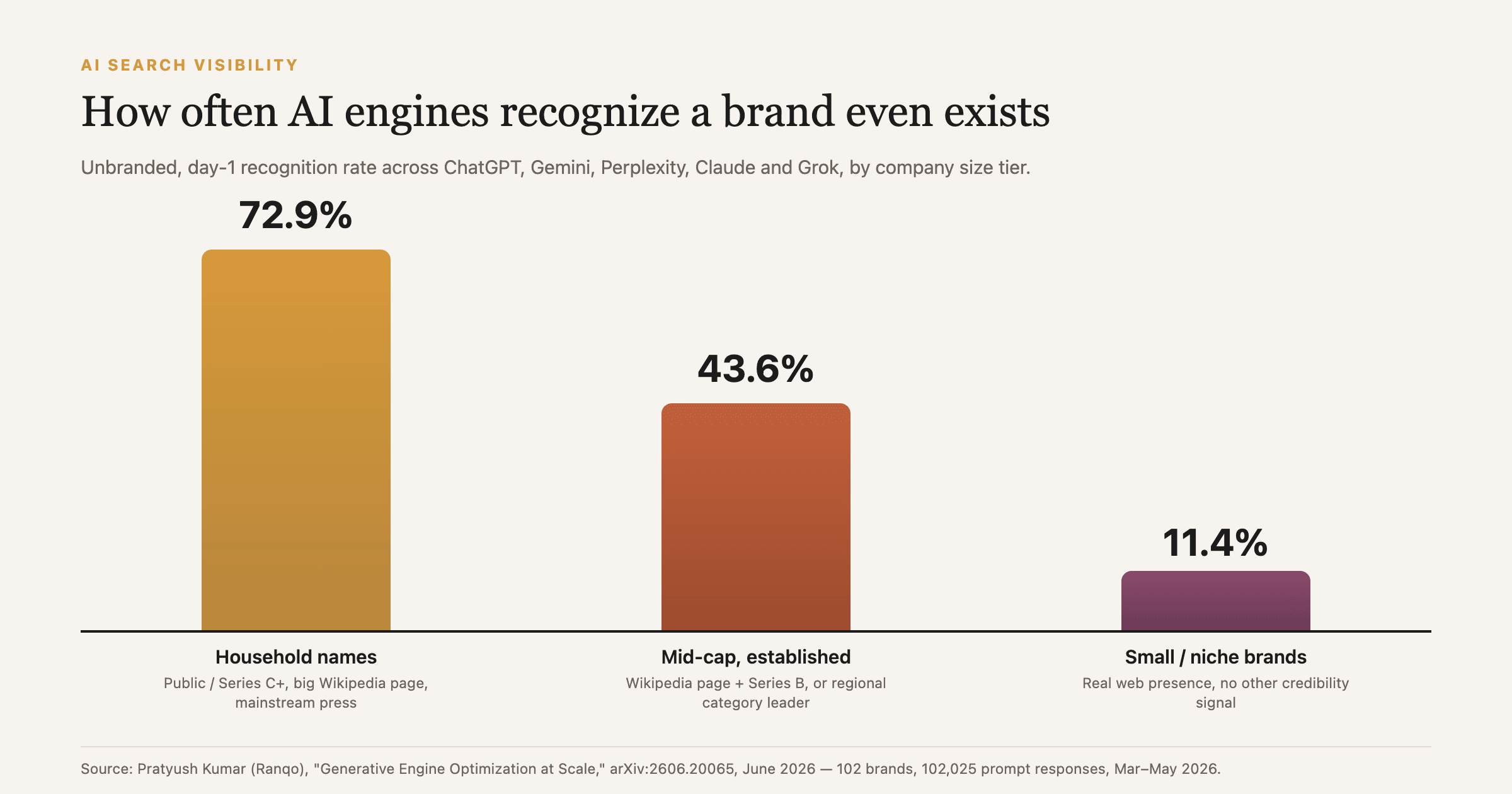
The study's brand-tier data explains why this hits small and mid-size businesses hardest. Ranqo split its 102 brands into three tiers by objective criteria, not perception, and measured "day-1 unbranded recognition": whether an AI engine even surfaces the brand for a relevant unbranded query, before any optimization work. Household names (public companies or Series C+, a Wikipedia article over 5,000 words, mainstream press coverage) hit 72.9% recognition. Established mid-cap brands (a Wikipedia page plus Series B funding, or clear regional category leadership) reached 43.6%. Brands with a real, legitimate web presence but none of those other credibility signals averaged just 11.4%, with a wide confidence interval (4.2-20.3%) reflecting how unevenly even that low floor is distributed.
That's roughly a 29-32 percentage point step down at each tier, which means a well-run small business isn't losing a close race for AI visibility, it's starting from a structurally different position than a Series C company gets by default, before either one writes a single word of GEO-focused content. If you run a niche or local business, this is worth knowing plainly rather than discovering it by wondering why your excellent content underperforms competitors who simply have more institutional weight behind them already.
What this actually means for your GEO plan
None of this makes owned-site content pointless, but it does reframe what that content is for. A few things follow directly from the data:
- **Build for the comparison query, on someone else's page and your own.** If "best X for Y" pages capture a fifth of all citations, get listed accurately on the real, established comparison and review sites in your category, and consider publishing your own honest comparison content, one that includes real competitors, not just a thinly disguised sales page, since that's the format the retrieval step is actually matching against.
- **Treat entity credibility as infrastructure, not a footnote.** A Wikipedia-notable profile, consistent press coverage, and a clear funding or leadership story are the exact inputs behind the tier gap above. None of that happens from a single blog post, but ignoring it means competing for the 11.4% floor indefinitely.
- **Track citations, not just impressions.** Knowing whether your brand shows up on unbranded prompts, not just when someone types your name, is the only way to see the gap this study measured. We covered the tooling and GA4 setup for this in how to track AI search traffic.
- **Don't confuse "we appeared once" with "we're recognized."** The study found unbranded recognition is highly inconsistent run to run for smaller brands specifically, so a single good result in ChatGPT isn't evidence of durable visibility the way it might be for an established brand.
This is exactly the gap AI Marketing Engine is built to close for founders and small teams: not just how to write AI-citable content, but how to build the entity credibility, third-party presence, and comparison-format strategy that this data shows actually earns a citation, instead of publishing into the 2.9% slice and wondering why nothing moves.
Go deeper
The AI Marketing Engine
Want the full The AI Marketing Engine course, not just this post?
Join the waitlist and get a 20% launch discount the moment we open checkout. No payment now.
Taught by Aditya Jha · 40+ AI products shipped for real clients. No spam, unsubscribe any time.
Or join our free community for AI tips while you wait
One email a week: the AI tools, tactics, and course drops actually worth your time. No spam, unsubscribe anytime.
Questions about this or which course fits? Email academy@aibootstrapper.com and we'll answer it directly, not with a support ticket.