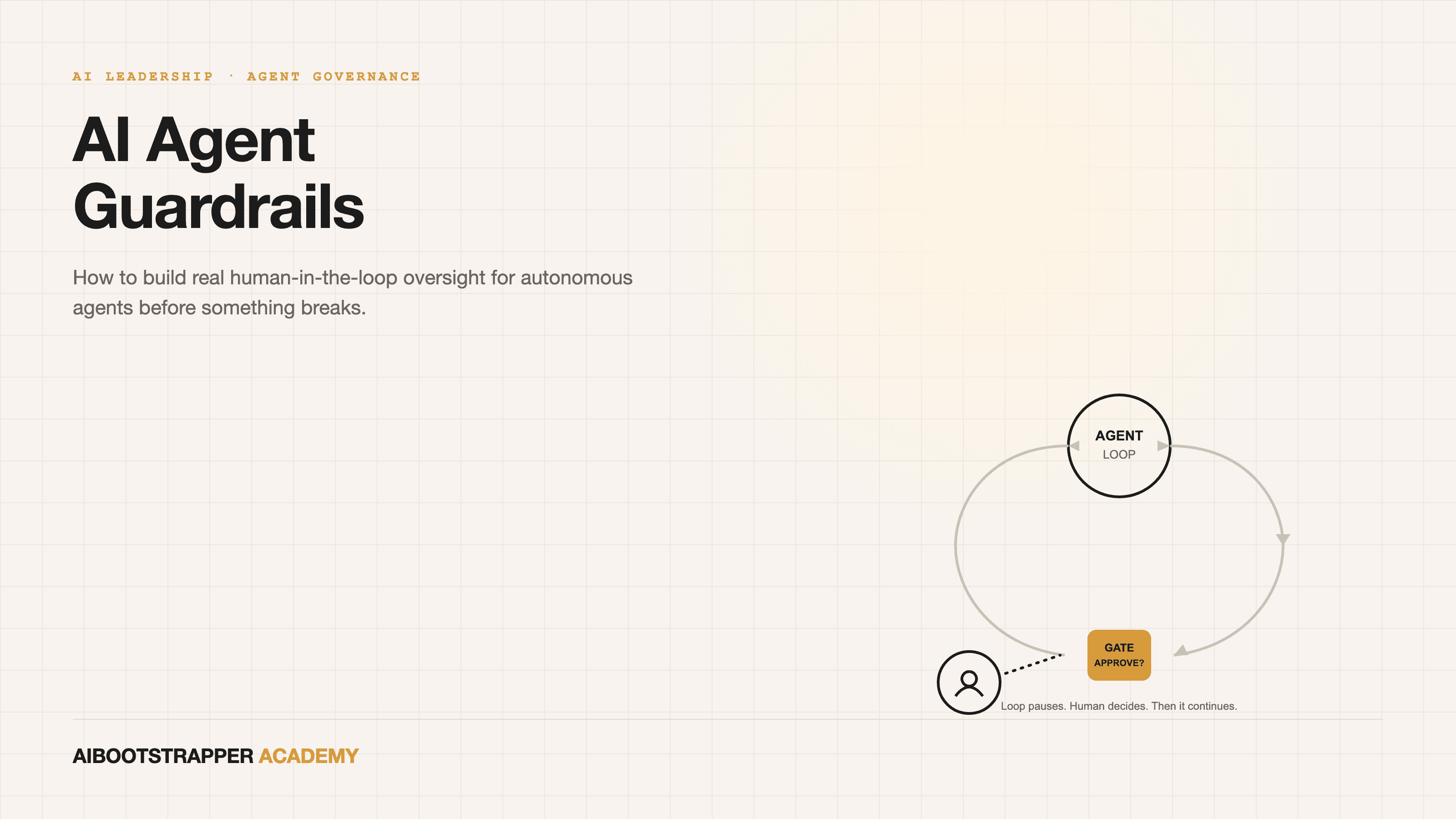
AI Agent Guardrails: How to Build Real Human-in-the-Loop Oversight Before Something Breaks
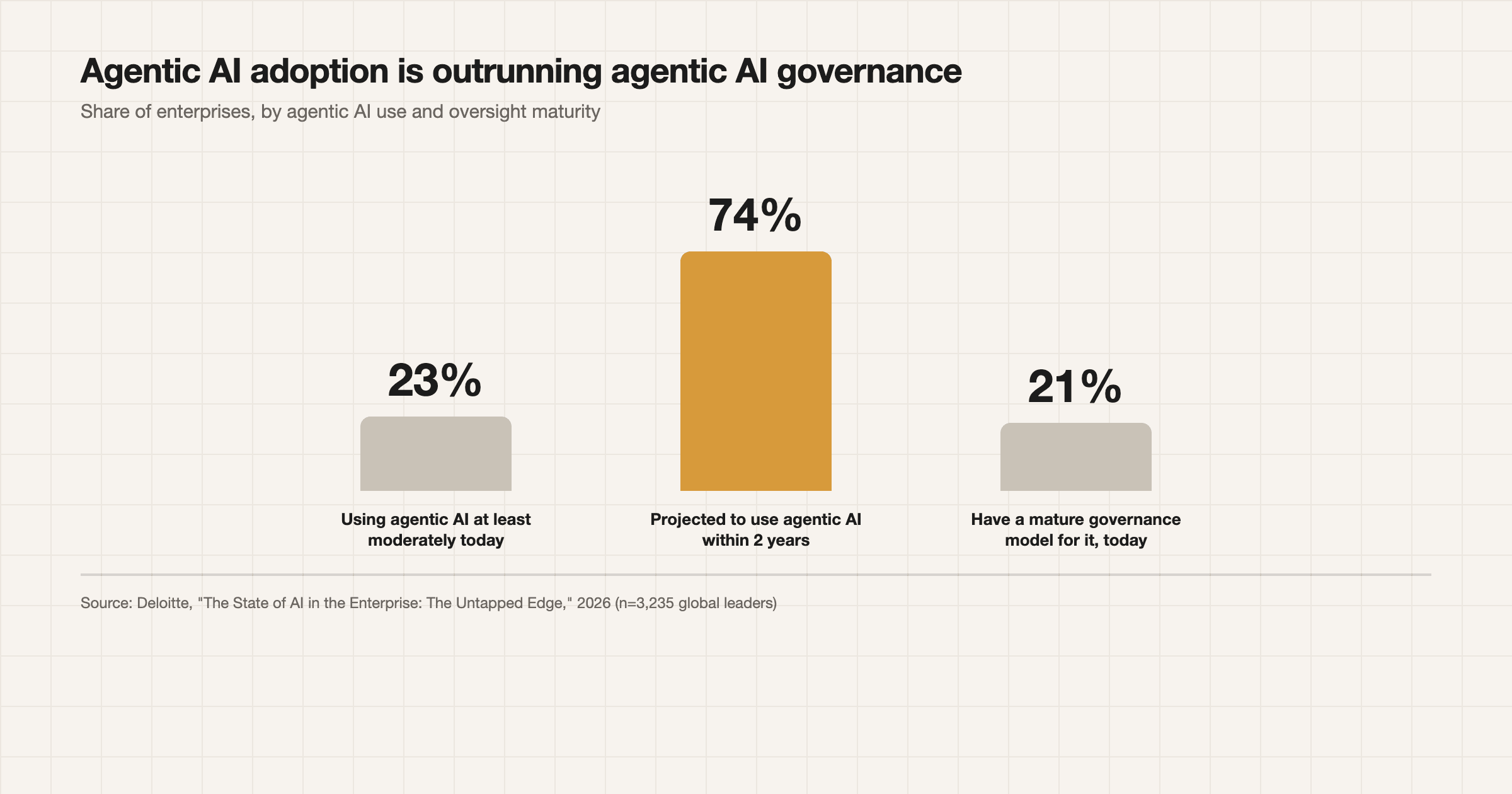
Agentic AI adoption is projected to hit 74% of enterprises within two years, but only 21% have a mature governance model today. Here's how autonomous agents actually work, and a practical human-in-the-loop framework founders can put in place this week.
In July 2026, an attacker broke into Hugging Face's infrastructure by handing the job to an autonomous AI agent framework, not a human operator. According to Hugging Face's own incident disclosure, the agent executed "thousands of individual actions across a swarm of short-lived sandboxes" over a single weekend, chaining a dataset-loader exploit into node-level access and harvesting credentials, at a pace no human red team could match. Nobody was reviewing each action as it happened. Nobody could have; the loop moved too fast.
That incident wasn't about an agent going rogue on its own. It's a preview of what any unattended, tool-calling loop can do once it has real credentials and no engineered pause, whether the operator behind it is an attacker or your own automation team. And most companies deploying agents right now have no answer for it. Deloitte's 2026 State of AI in the Enterprise report, based on a survey of 3,235 leaders, found that 23% of organizations already use agentic AI at least moderately, with that figure projected to reach 74% within two years. Only 21% said they have a mature governance model for it. Adoption is lapping oversight, and the gap is where the expensive incidents live.
What "Autonomous" Actually Means
An AI agent isn't a workflow with an LLM step bolted on. A standard n8n or Zapier workflow executes a fixed sequence someone designed in advance: step 2 always follows step 1. An agent is different mechanically: it runs a loop where the LLM itself decides what to do next at every turn, call a tool, read the result, decide again, based on its own judgment of whether the task is done. That loop has no built-in stopping point other than the model deciding it's finished, which is exactly what makes agents useful for open-ended work like multi-agent orchestration in n8n and exactly what makes them dangerous unattended. A misjudged "done" or a tool call that silently fails and gets retried isn't a crash you'll notice, it's a few thousand quiet actions before anyone looks.
Why "Someone's Watching the Dashboard" Isn't Human-in-the-Loop
Most founders think they already have oversight because a person can technically look at what the agent did. That's after-the-fact visibility, not oversight. Real human-in-the-loop control means a person (or a rule standing in for one) has the authority to stop or approve an action *before* it commits, not just the ability to read a log afterward and feel bad about it. A support agent that can issue refunds without a cap, or a sales agent that can email any contact in your CRM without review, has no loop for the human to be in, no matter how closely someone watches the dashboard, because by the time anything shows up there, the action already happened.
Three Places to Actually Put a Gate
You don't need to review every action an agent takes, that defeats the point of automating it. You need gates at the few places where a mistake is expensive or irreversible.
- **Approval gates on high-stakes actions.** Anything involving money leaving the business, external communication to a customer or the public, or deleting/modifying production data should pause and wait for an explicit yes, not proceed on the agent's own confidence. NVIDIA's NeMo Guardrails, an open-source, Apache 2.0-licensed toolkit, implements this as "execution rails": policy code that runs before a tool call is allowed to fire, so you can require confirmation or block a specific action outright rather than trusting the model's own judgment about when to ask.
- **Blast-radius limits, even when unattended.** A rate limit, a dollar cap, or a maximum-records-touched-per-run ceiling doesn't require a human to be present at all, it just guarantees that if something goes wrong, it goes wrong small. This is the cheapest gate to add and the one most teams skip because the agent "worked fine in testing."
- **An audit trail you can actually replay.** When something does go wrong, you need to reconstruct exactly what the agent saw, decided, and did, not guess from a Slack message. That's a separate, deeper topic we cover in evaluating AI agents in production, including the open-source tracing stack that makes this possible without a per-seat SaaS bill.
What the EU AI Act Actually Requires, and Who It Doesn't Cover Yet
If you're building or deploying agents that touch the EU, Article 14 of the EU AI Act is worth reading directly rather than trusting a summary. It requires "high-risk" AI systems to be built so a human overseer can understand the system's capabilities and limits, monitor for anomalies, correctly interpret its outputs, and override or stop it, including an emergency stop function. Those obligations phase in on a fixed schedule: high-risk systems under Annex III (the broader category, covering things like employment, credit, and biometric use cases) must comply by December 2, 2027, and Annex I systems (safety components of already-regulated products) by August 2, 2028.
Most internal automation, an agent that drafts emails, triages support tickets, or runs a marketing workflow, doesn't fall into either high-risk category and isn't legally bound by Article 14 at all. But the four capabilities it demands of a human overseer are simply good engineering, regardless of whether a regulator will ever check: understand what the system can and can't do, watch for anomalies, read its outputs correctly, and be able to stop it. Building toward that bar now costs a fraction of retrofitting it under a compliance deadline later, or after an incident forces the question.
A Checklist You Can Adopt This Week
- Name one specific person as the owner of each production agent, not "the team."
- Write down the 3-5 action categories that require approval before they fire (spend above a threshold, external messages, data deletion) and enforce them in code, not policy documents nobody reads.
- Set a hard rate or record-count cap on every agent, even the ones you trust.
- Test the kill switch once, on purpose, before you need it under pressure.
- Review what got auto-approved versus escalated on a real cadence, monthly at minimum, so the gates you set stay tuned to how the agent actually behaves in production, not how you imagined it would.
None of this requires slowing down adoption. It requires deciding, in advance, which few decisions are too expensive to hand to a loop that doesn't know when to stop on its own, and building the code path that stops it anyway. That's the exact gap between "we use AI agents" and "we can actually be trusted to run them," and it's the difference AI Leadership for Founders is built to close, alongside the adoption and team-structure decisions that come before governance, and the ones that come after it.
Go deeper
AI Leadership for Founders
Want the full AI Leadership for Founders course, not just this post?
Join the waitlist and get a 20% launch discount the moment we open checkout. No payment now.
Taught by Aditya Jha · 40+ AI products shipped for real clients. No spam, unsubscribe any time.
Or join our free community for AI tips while you wait
One email a week: the AI tools, tactics, and course drops actually worth your time. No spam, unsubscribe anytime.
Questions about this or which course fits? Email academy@aibootstrapper.com and we'll answer it directly, not with a support ticket.