Who Should Own GEO? What a 2026 Survey of 150 B2B Marketers Reveals
A 2026 report on 150 B2B tech marketers found no department owns generative engine optimization, and 51% blame a real skills gap, not the org chart. Here is what the data says actually separates teams that get cited from teams that don’t.
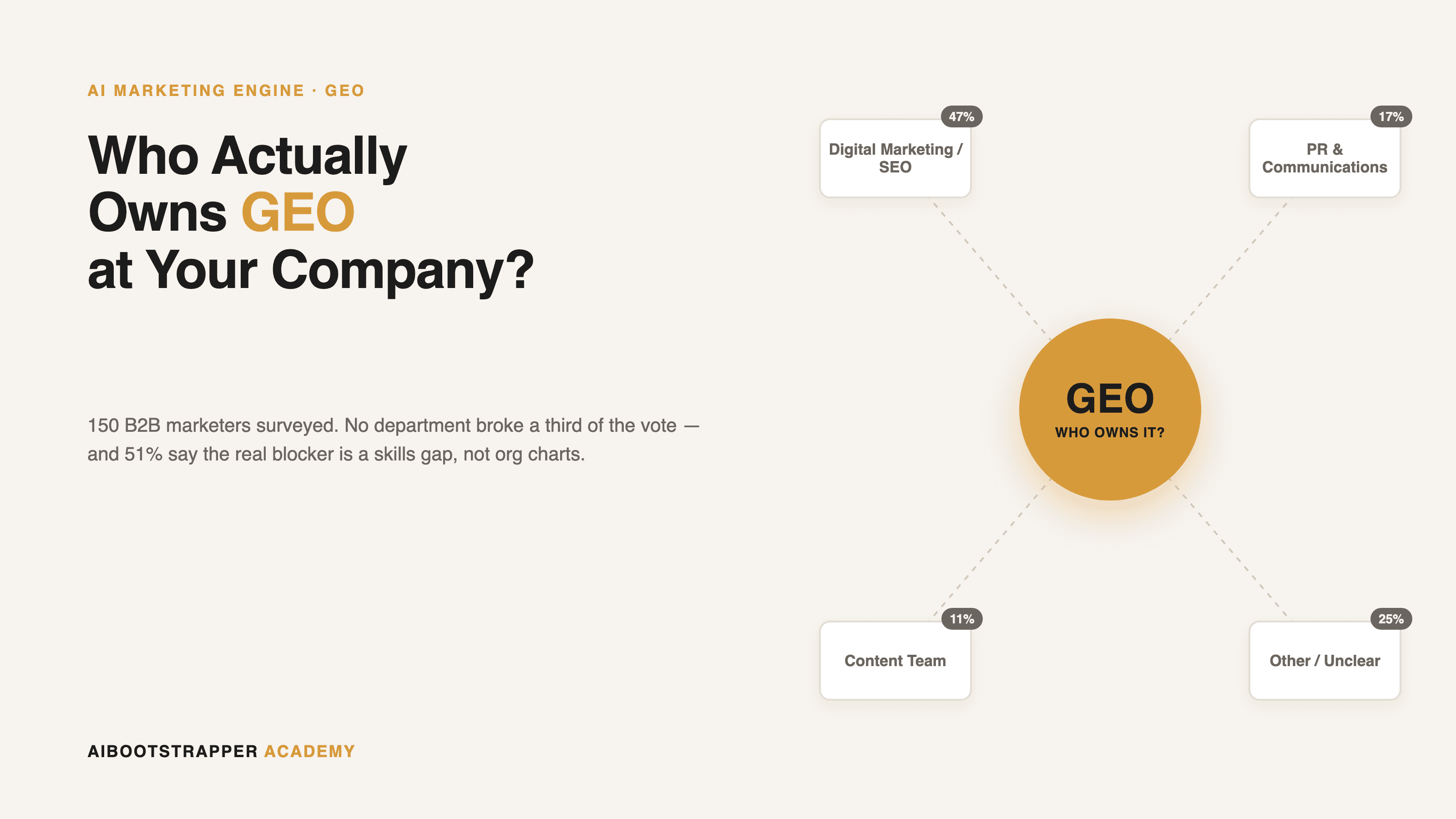
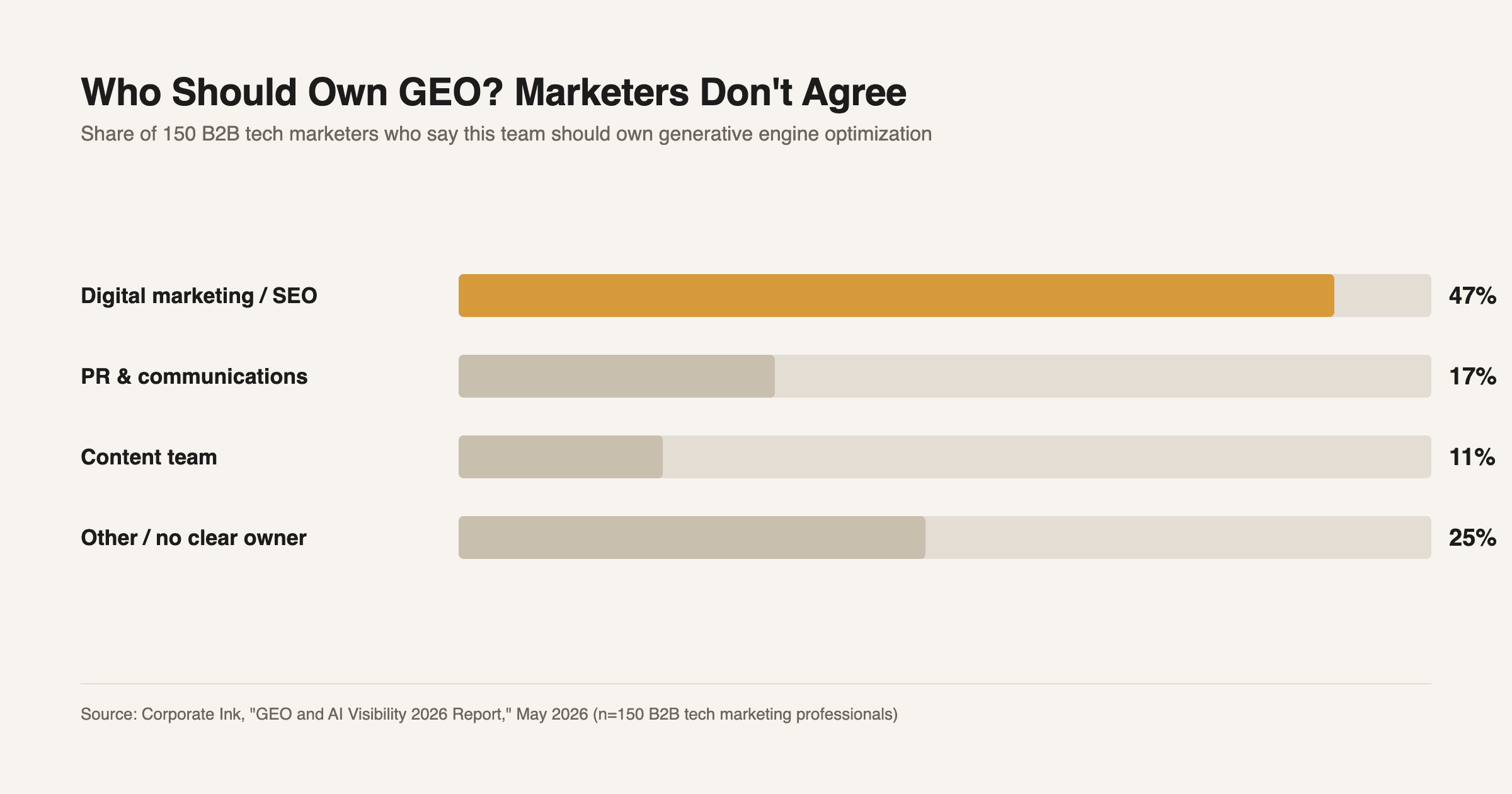
Ask a marketing leader who owns GEO at their company and you'll get a confident answer. Ask three, and you'll get three different confident answers. That's not an anecdote, it's the actual finding of the GEO and AI Visibility 2026 Report from Corporate Ink, which surveyed 150 B2B tech marketing professionals, CMOs, VPs, directors, and managers, across the US in May 2026: 47% think digital marketing and SEO should own generative engine optimization, 17% say PR and communications, and 11% say the content team. No group breaks a third of the vote. The other 25% is scattered across product marketing, growth, and "nobody has said."
That split matters less on its own than what it's covering for. The same report asked marketers what's actually stopping them from improving AI visibility, and ownership confusion wasn't the top answer. 51% cited "limited internal GEO knowledge and expertise" as their biggest obstacle, ahead of the 39% who pointed to poor coordination across content, PR, and web teams. The org chart fight is a symptom. The real problem is that most people who'd be handed the job don't yet know how to do it.
What GEO Work Actually Requires
Part of why the skills gap is real, not just a training-budget excuse, is that GEO isn't a settings toggle on top of existing SEO work. It's a different set of mechanics layered onto some overlapping ones.
Traditional SEO optimizes for a ranking algorithm that returns a list of links for a human to click through. GEO optimizes for a retrieval-and-synthesis pipeline: an AI model retrieves a set of candidate pages (Bing's index for Copilot, its own crawl and Bing for ChatGPT, its own index for Google's AI Overviews and Gemini), scores them for relevance and trustworthiness, then generates an answer that either quotes or paraphrases a handful of sources and cites even fewer. Ranking #3 on Google can still get you cited; ranking #1 with thin, unstructured content often won't. As we covered when AirOps published retrieval data on 548,534 pages, ChatGPT cites only about 15% of what it retrieves, and what separates the cited 15% is structure and trust signals the retrieval model can actually parse, not just topical relevance.
That means a marketer doing GEO well needs to understand things a traditional SEO generalist usually doesn't touch day to day:
- How to structure a page so a specific paragraph, not just the page as a whole, can be lifted cleanly into an AI-generated answer
- How entity clarity works, making sure your brand, product, and claims are unambiguous enough for a model to attribute correctly rather than merging you into a category
- How to monitor citations across four or five different AI platforms that each surface differently and don't share a dashboard the way Google Search Console does
- Why some tactics that work for Google's AI Overviews, like backlink-driven authority, barely move ChatGPT's citation behavior at all, because the two systems weight sources differently
None of that is intuitive from an SEO background, and none of it is taught in a typical marketing degree or bootcamp built before 2024. That's the actual shape of the 51% gap.
Why the Skills Gap Outweighs the Turf War
It's tempting to read the ownership numbers as a political problem, get the C-suite to pick a lane, and assume execution follows. A separate Semrush study of 481 marketers and SEO professionals, published in June 2026, suggests that's backwards. Only 22% of respondents said their SEO and AI-search efforts are fully integrated across strategy, execution, and reporting, and integration correlated far more with outcomes than which department was in charge.
The gap between integrated and fragmented teams was large: 81% of fully integrated teams reported more AI-platform-driven traffic and leads, versus just 36% of teams running SEO and GEO as separate tracks. Measurement infrastructure tracked the same way: 41% of teams seeing results said AI visibility was "clearly measurable and actionable" for them, against 15% of teams that weren't seeing results. Teams getting results were also more than twice as likely to use dedicated AEO or GEO monitoring tools, 45% versus 19%.
In other words, the org chart matters less than whether the people doing the work actually know how to structure content, read citation data across platforms, and close the loop between what they publish and what gets cited. A GEO program owned by the "right" department with no one on it who understands entity structuring or cross-platform monitoring will still produce the 78% outcome, not the 22% one.
What Closing the Gap Actually Looks Like
Concretely, the marketers on the winning side of that 22%-vs-78% split tend to do three things the rest skip:
- They treat AI citation tracking as its own discipline, not a Google Search Console add-on, because ChatGPT, Perplexity, Gemini, and Google's AI Overviews each crawl, weight, and cite differently.
- They rewrite existing high-performing content for retrieval, not just add new content, restructuring key paragraphs into direct, self-contained answers instead of waiting for the next content calendar cycle.
- They put one person or a tight pod through structured, current training, rather than distributing "keep an eye on AI search" as a part-time responsibility across five people who each own 20% of it and none of it.
If you're doing this on your own time, there are genuinely good free starting points: Google's AI Essentials covers the underlying AI literacy, and Coursera's AI SEO / GEO course is a reasonable four-hour primer on the transition from keyword-era SEO thinking to answer-era GEO thinking. Both are worth doing before you touch a single page on your own site, exactly the same "learn the mechanism first" advice we gave in GEO vs SEO: What Actually Changes. What neither gives you is the applied, current playbook: how to actually restructure a page, build and run an AI avatar and UGC pipeline that produces citable content at volume, and set up performance campaigns around what's working, in sequence, on your own brand.
Where This Fits If You're the One Closing the Gap
If you read the 51% number and recognized your own team, or yourself, the fix isn't a vague mandate to "get better at AI search." It's the specific, sequenced skill set the data above points to: content structured for retrieval, entity clarity, cross-platform citation monitoring, and a workflow that ties GEO into the rest of the marketing engine instead of running it as a side project.
That's the exact ground The AI Marketing Engine course covers in its third week, structuring content so AI search engines actually start citing your brand, built on top of the AI avatar and UGC production system taught in the first two weeks, so the content you're structuring for GEO is content you can actually produce at the volume this requires. It won't fix your company's org chart, but it closes the part of the gap that's actually yours to close.
Go deeper
The AI Marketing Engine
Want the full The AI Marketing Engine course, not just this post?
Join the waitlist and get a 20% launch discount the moment we open checkout. No payment now.
Taught by Aditya Jha · 40+ AI products shipped for real clients. No spam, unsubscribe any time.
Or join our free community for AI tips while you wait
One email a week: the AI tools, tactics, and course drops actually worth your time. No spam, unsubscribe anytime.
Questions about this or which course fits? Email academy@aibootstrapper.com and we'll answer it directly, not with a support ticket.