Brand Mentions Beat Backlinks for AI Citations — But Mostly on Google, Not ChatGPT
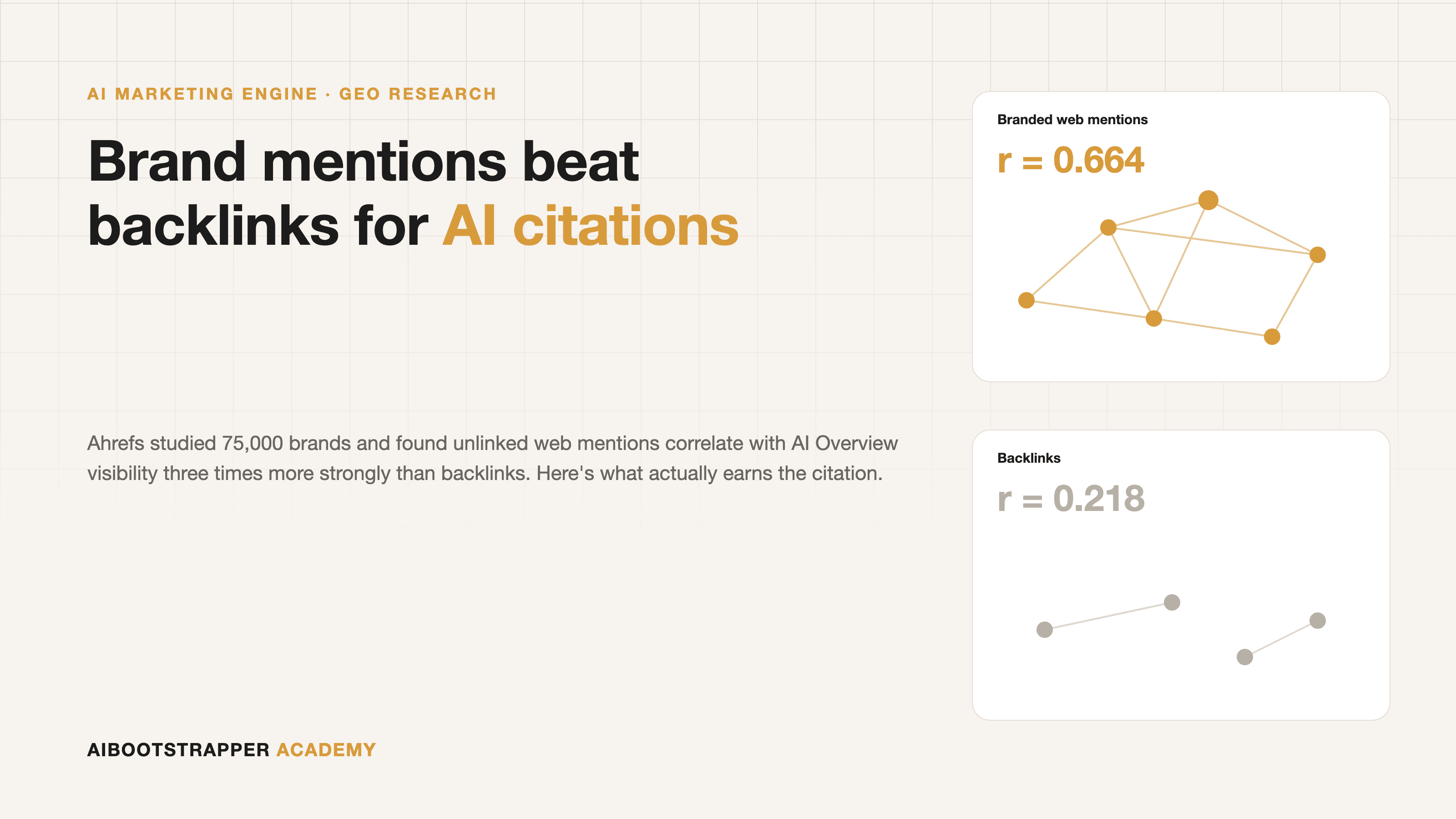
Ahrefs studied 75,000 brands and found unlinked web mentions correlate with AI Overview visibility three times more strongly than backlinks. A second study shows why that only holds on Google.
If you've spent any time optimizing content for AI search this year, you've probably heard some version of "backlinks still matter for GEO." Ahrefs tested that assumption against 75,000 real brands in May 2025, and the data pointed somewhere else entirely: the strongest predictor of whether a brand gets cited in Google's AI Overviews wasn't backlinks at all. It was how often the brand gets mentioned across the web, whether or not those mentions link back.
What Ahrefs actually measured
Ahrefs' content team, led by Louise Linehan and data scientist Xibeijia Guan, pulled 75,000 brands with a Domain Rating above 40 and a highest-volume keyword getting at least 800 monthly searches, then ran Spearman rank correlations between nine off-site and on-site signals and how often each brand showed up in Google AI Overviews. About 26% of brands in the sample had zero AI Overview mentions at all, so the correlations below are drawn from the roughly 74% that appeared at least once.
The ranked results were not close:
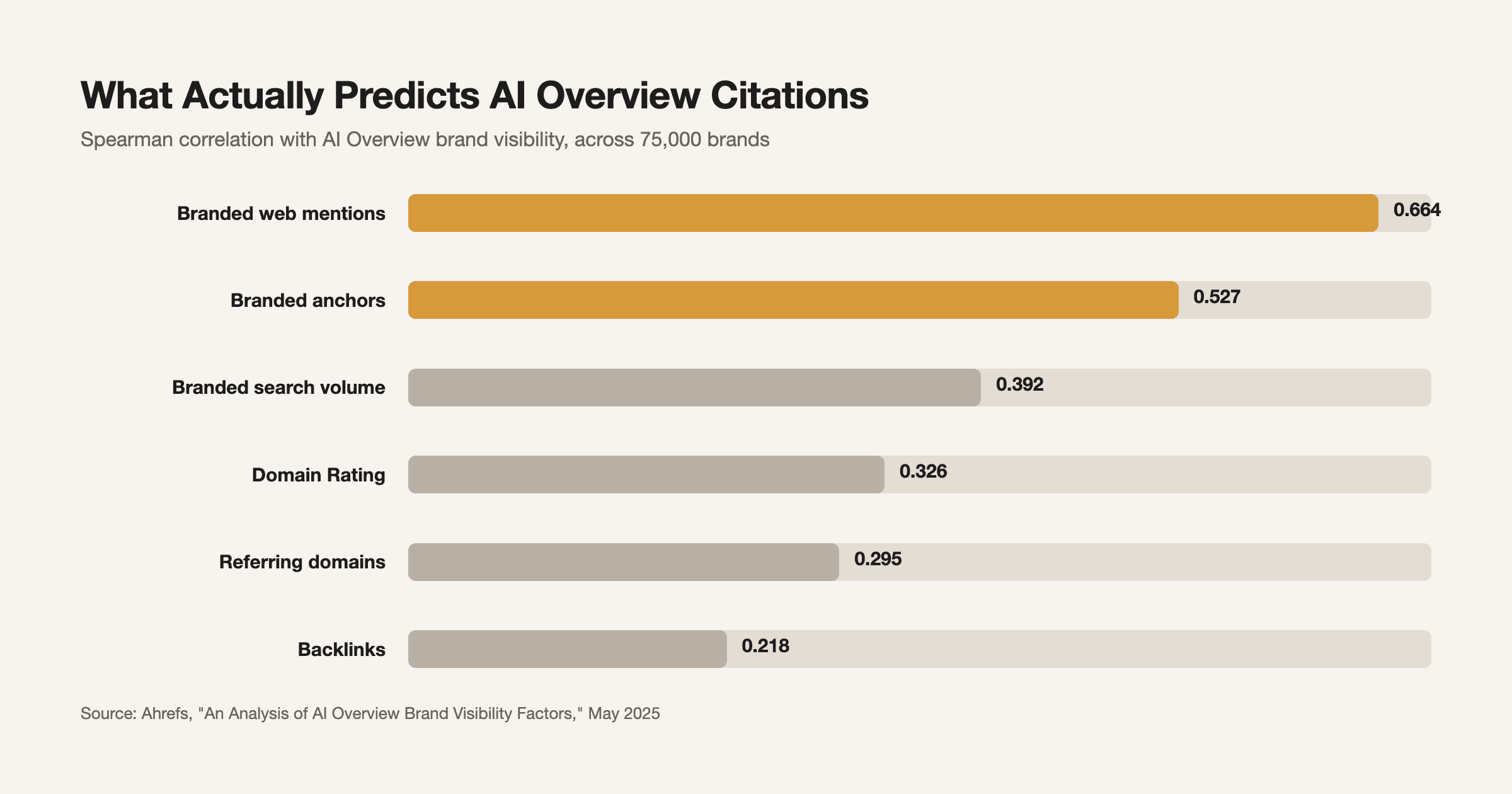
Branded web mentions correlated at 0.664. Backlinks came in at 0.218, ranked below domain rating (0.326) and even referring domains (0.295). Brands in the top 25% for web mentions averaged 169 AI Overview mentions, versus just 14 for the next quartile down, a 10x gap between "frequently talked about" and "occasionally talked about," with no requirement that any of those mentions carried a clickable link.
Why an unlinked mention outperforms a link here
This flips a rule that's held for two decades of SEO. A backlink has always been the unit of trust because it's costly to fake: someone had to publish it, and it passes measurable link equity. A plain-text mention of your brand name, with no link at all, has never mattered much for classic search rankings.
Ryan Law, Ahrefs' Director of Content Marketing, put it directly: "Unlinked mentions have very little impact on SEO, but a much bigger impact on GEO." The mechanism makes sense once you think about what an AI answer engine is actually doing. It isn't crawling a link graph to compute authority the way PageRank does. It's retrieving passages and summarizing what's said about a topic, and a summarization model treats "TechCrunch called Notion a leading project management tool" as a real signal whether or not that sentence happens to be a hyperlink. The brand's name appearing, repeatedly, in independent, third-party text is itself the evidence the model is weighing. We covered the mechanical side of this shift in GEO vs SEO: what actually changes; this study is the clearest data yet for why "get mentioned" and "get linked" have started to pull apart as separate goals.
It depends heavily on which AI you're trying to reach
Here's the part that gets left out of most summaries of this study, and it matters if you're actually deciding where to spend a GEO budget. A separate Ahrefs analysis by technical SEO lead Patrick Stox looked at the same relationship, branded web mentions versus visibility, but split it across three AI systems using a month of real usage data: 76.7 million Google AI Overviews, 957,000 ChatGPT prompts, and 953,500 Perplexity prompts from June 2025.
| AI system | Correlation (mentions → visibility) |
|---|---|
| Google AI Overviews | 0.65 |
| Perplexity | 0.30 |
| ChatGPT | 0.15 |
Brand mentions predict citation strongly on Google, weakly on Perplexity, and barely at all on ChatGPT. Stox's read is that Google has spent two decades building entity-recognition and brand-trust systems into its core algorithm, and AI Overviews inherits that machinery, while ChatGPT's retrieval and ranking stack was built from a different foundation that doesn't lean on the same signals. If your GEO strategy is "get mentioned everywhere and it'll pay off across every AI surface," the actual data says you're mostly buying Google AI Overview visibility, not a universal citation multiplier.
Correlation is not the whole story
Worth saying plainly: none of this proves mentions cause citations. Big, well-known brands naturally accumulate both more mentions and more citations, because journalists and AI systems both gravitate toward brands people already recognize, which is a form of the same underlying popularity rather than one causing the other. Ahrefs' own researchers frame this as a correlation study, not a controlled experiment, which puts it in a different category of evidence than, say, the controlled schema-markup test Ahrefs ran the following year, where they could isolate a single variable and measure a real before/after effect. Treat "increase your mentions and you'll get more citations" as a strong, well-supported hypothesis worth acting on, not a proven mechanism.
What to actually do with this
The practical shift is from chasing links to earning coverage, whether or not that coverage links back. A few things follow directly from the data:
- **Give people a reason to write your name.** Publishing original data, a benchmark, or a survey result that a journalist can cite verbatim is what earns organic mentions in the first place; nobody name-drops a product page.
- **Reclaim what already exists.** Warm outreach to a publication that already mentioned you unlinked converts at 15 to 40%, versus 3 to 8% for a cold link request, because you're asking for an edit to something they already decided was worth writing, not a new editorial decision.
- **Track mentions, not just links.** Google Alerts and F5Bot (free, watches Reddit, Hacker News, and Lobsters for your brand name) cover the basics at no cost; Ahrefs' own Brand Radar and tools like Mention or Brand24 add sentiment and volume tracking for a paid tier.
- **Work the journalist-request channel.** With HARO's original form defunct, Featured, Qwoted, and the free Source of Sources are the current channels for getting quoted, and quoted usually means mentioned.
One of our own clients saw this play out directly. As Rahul Mehta, founder of a B2B SaaS company we worked with, put it in AIBOOTSTRAPPER client feedback: "We came for a website and left with an entire AI growth system. Within 90 days we were getting cited by ChatGPT for our category and our inbound doubled." The website was never the lever. The mentions and positioning work built around it was.
Where this fits if you're building a GEO strategy
Chasing citations by pattern-matching a single correlation study is how most "AI SEO" advice goes wrong. The stronger approach treats mention-building as one input alongside content structure, technical crawlability, and platform-specific tactics, since as this data shows, what wins you a citation on Google's AI Overviews is not the same lever that moves ChatGPT. That's the actual curriculum inside AI Marketing Engine: how to build the digital-PR and content systems that earn real mentions, and how to read studies like this one for what they actually support instead of turning a single correlation into a rulebook.
Go deeper
The AI Marketing Engine
Want the full The AI Marketing Engine course, not just this post?
Join the waitlist and get a 20% launch discount the moment we open checkout. No payment now.
Taught by Aditya Jha · 40+ AI products shipped for real clients. No spam, unsubscribe any time.
Or join our free community for AI tips while you wait
One email a week: the AI tools, tactics, and course drops actually worth your time. No spam, unsubscribe anytime.
Questions about this or which course fits? Email academy@aibootstrapper.com and we'll answer it directly, not with a support ticket.