Do You Need a Chief AI Officer? A Founder's Framework for Fractional vs Full-Time vs DIY
Chief AI Officer adoption nearly tripled in a year, but that doesn't mean every founder needs a hire. Here's how to decide between fractional, full-time, and doing it yourself.
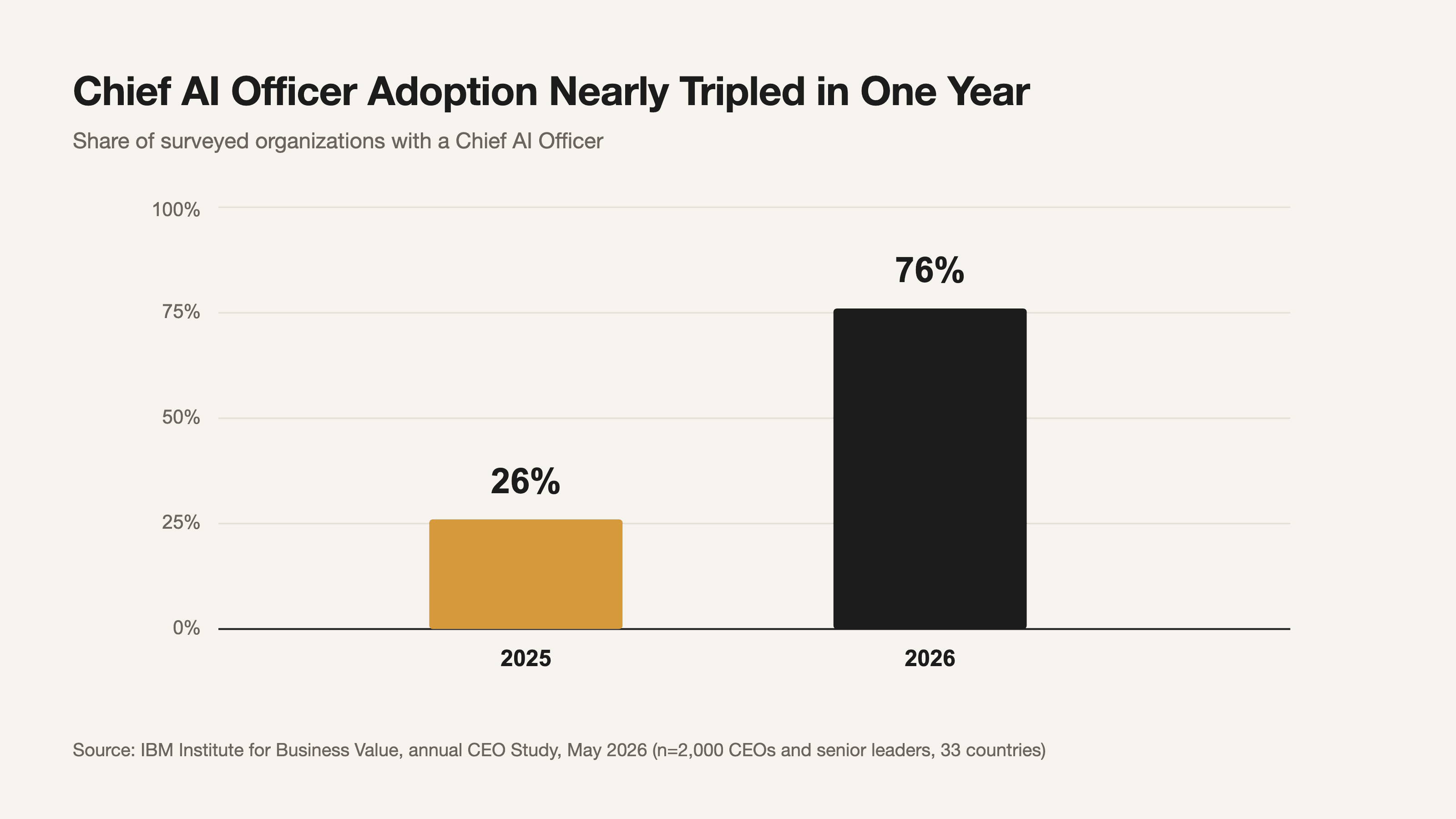
In 2025, only 26% of organizations had a Chief AI Officer. A year later, IBM's 2026 CEO study put that number at 76%, based on 2,000 CEOs and senior leaders surveyed across 33 countries. That's not a title getting added because it sounds good on a slide. It's founders and boards deciding that "someone owns AI, part time, alongside their other job" stopped working somewhere around the same time 80% of CEOs told Gartner AI will force a rebuild of how their company operates, not just a new tool in the stack.
If you run a company under 50 people, that 76% number isn't a hiring mandate. It's a prompt to actually answer a question most founders skip: does this need a hire at all, and if so, what kind?
What a Chief AI Officer actually owns
Strip away the title and the job is three things: a ranked, ROI-ordered roadmap of what AI bets are worth funding this quarter, a governance layer that decides what tools and data practices are allowed (the same gap we covered in how to build an AI tool approval process), and an accountability line so that when someone asks "did the AI spend pay off," there's one person who has to answer, not a committee that shrugs. More than half of CAIOs report directly to the CEO or board, which tells you this is being treated as a P&L-adjacent role, not a technical one bolted onto engineering.
The reason this role exists at all traces back to a gap we've written about before: 87% of leaders report 5x productivity gains from AI, but only 29% see it show up as measurable ROI. Someone has to close that gap on purpose. Left to itself, it doesn't close. It's the same gap a COO at a RegTech company described after bringing in outside AI strategy help: "Their AI consultancy gave us a roadmap we could actually act on. No buzzwords, just where AI would make money, ranked by ROI" — feedback from an AIBOOTSTRAPPER consulting client, not a course review, but the exact job description of whoever ends up owning this at your company, hired or not.
The three models, compared
Nobody under 50 employees should default to a full-time hire, and almost nobody over 200 should keep winging it with founder time alone. Here's roughly where the tradeoffs sit, based on current market rates from recruiters and fractional-leader placement firms:
| Model | Typical cost | Time to value | Best fit |
|---|---|---|---|
| Founder-led (no hire) | $0 direct, but founder's time | Immediate, but caps out fast | Under ~15 people, one or two AI use cases total |
| Fractional CAIO | $4,000–$25,000/month depending on hours | 4–8 weeks to a working roadmap | Ungoverned AI sprawl, stalled pilots, board asking questions leadership can't answer |
| Full-time CAIO | $250K–$500K+ base, often with equity | 8–14 week search, then 1–2 quarters to ramp | AI is now core to the product or a major cost line, not just a productivity layer |
The fractional numbers are wide because the role itself is scoped in hours: a strategic advisor at 8 hours a month looks nothing like an embedded operating partner at 30+. Ask for the hours before you compare the monthly rate, or you're comparing apples to a much smaller apple.
When fractional is the right call
Fractional makes sense when the underlying problem is direction, not headcount. The signals worth watching for: AI tools have sprawled across teams with no one tracking what's approved, two or three pilots have stalled without anyone able to say why, your CTO is already stretched thin and AI strategy is the thing sliding off their plate, or the board has started asking AI questions leadership can't answer with a straight face. None of those require a permanent seat, they require someone who's done this before to spend a focused quarter building the roadmap and the governance rails, then hand off.
The honest risk with fractional is the same risk as any consultant: if nothing is codified before they leave, the org reverts. The fix is contractual, not aspirational — the engagement should explicitly include documenting the decision framework and the approval process, not just running it while they're in the room.
When a full-time hire actually pays for itself
Full-time only clears its own cost when AI stops being "a way to work faster" and becomes a line item large enough to need daily ownership: a meaningful chunk of the product roadmap, a compute/API budget that needs active management, or a regulatory surface (an AI-specific disclosure rule or sector regulation) that needs someone accountable every week, not once a quarter. Below that threshold, a full-time CAIO is usually a senior person doing a part-time job at full-time comp, which is its own kind of expensive.
Or: don't hire anyone yet
The founder-led option isn't the consolation prize, it's frequently correct. If your company has one or two real AI use cases and a team small enough that you can still read every Slack thread about them, the fastest path is usually you, personally, spending a bounded amount of time building the ranked roadmap yourself rather than paying someone to build it for you. This is exactly the failure mode we mapped in why 95% of AI pilots fail to show ROI: the pilots that work aren't the ones with the fanciest owner, they're the ones with a specific, measured baseline and someone checking it every week. A founder can do that. A fractional hire brought in too early is often just an expensive way of avoiding that fifteen minutes a week yourself.
Getting the sequencing wrong is the actual cost
The expensive mistake isn't picking the wrong model, it's picking a model before you've named the problem. Hiring a full-time CAIO to fix what's actually a middle-manager adoption problem doesn't fix the middle-manager problem, it just gives it a more expensive owner. Bringing in fractional help to build a roadmap when the real issue is shadow AI already running unmanaged across the team means the roadmap gets built on top of a mess instead of before one. Name the actual bottleneck first. The org-chart question comes second.
If you're trying to figure out which bottleneck you actually have, and what a real, ranked AI roadmap looks like once you know, that diagnostic work is exactly what we walk through in AI Leadership for Founders: how to build the roadmap, fund the right bets, and know when you've outgrown doing this yourself, before you sign a contract or a job offer to find out the hard way.
Go deeper
AI Leadership for Founders
Want the full AI Leadership for Founders course, not just this post?
Join the waitlist and get a 20% launch discount the moment we open checkout. No payment now.
Taught by Aditya Jha · 40+ AI products shipped for real clients. No spam, unsubscribe any time.
Or join our free community for AI tips while you wait
One email a week: the AI tools, tactics, and course drops actually worth your time. No spam, unsubscribe anytime.
Questions about this or which course fits? Email academy@aibootstrapper.com and we'll answer it directly, not with a support ticket.