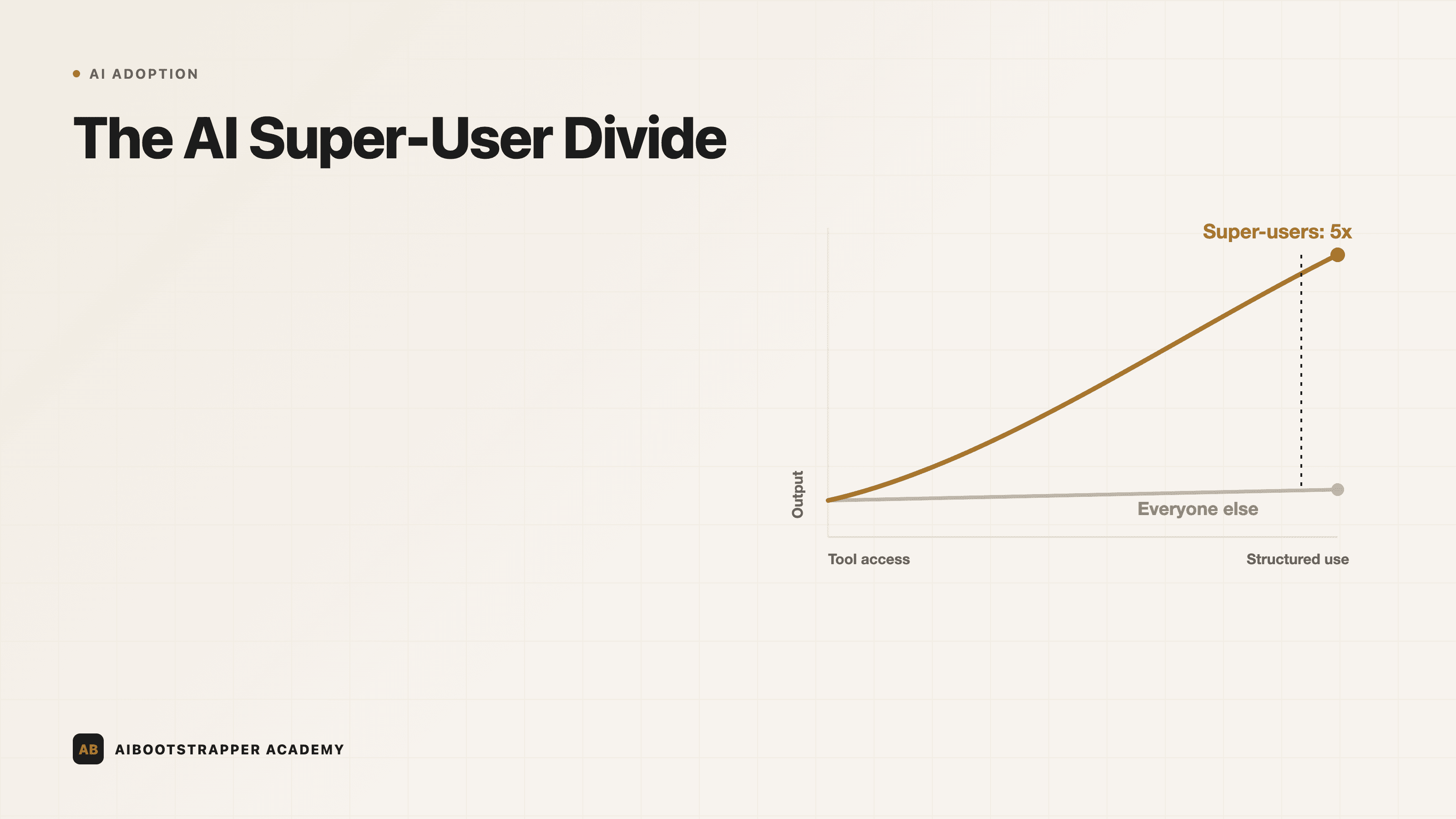
The AI Super-User Divide: Why 87% of Leaders See 5x Productivity Gains but Only 29% See ROI
A 2026 survey of 2,400 employees and C-suite leaders found AI "super-users" are 5x more productive, but most companies still can't show ROI from AI. Here's the actual mechanism behind that gap and what closes it.
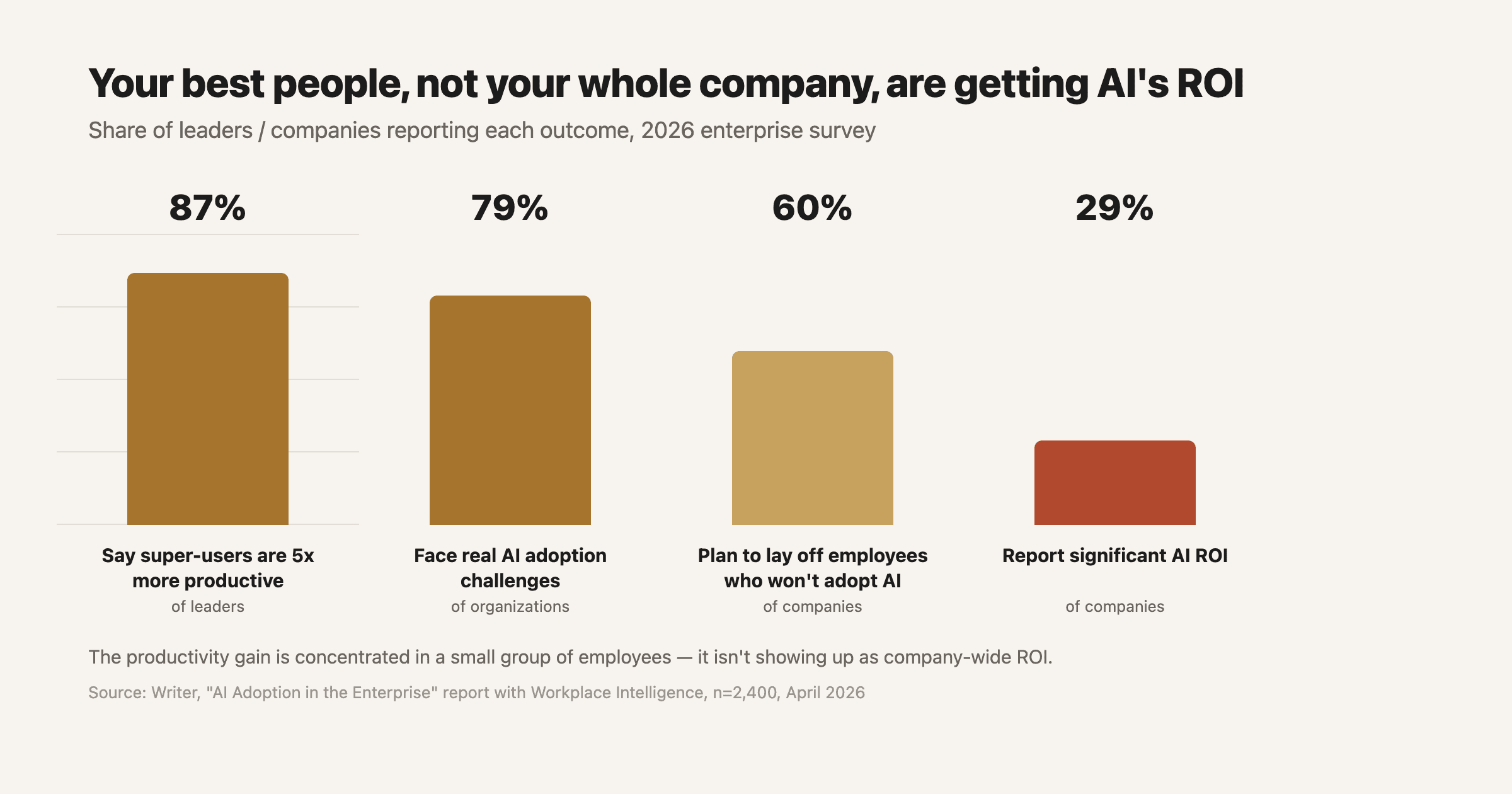
If you've handed out ChatGPT or Claude licenses to your whole team and productivity still looks flat on a spreadsheet, you're not imagining it and you're not alone. A 2026 survey of 2,400 employees and C-suite leaders found something that sounds like a contradiction until you look at where the gains actually land: 87% of leaders say their AI "super-users" are at least 5x more productive than employees who haven't embraced the tools, and only 29% of those same companies report significant ROI from AI at the organizational level. The productivity is real. It's just trapped in individuals instead of showing up in the business.
What the data actually says
The numbers come from Writer's "AI Adoption in the Enterprise" report, conducted with the independent research firm Workplace Intelligence, surveying 2,400 knowledge workers and C-suite executives across the US, UK, Ireland, Benelux, France, and Germany in early 2026. Beyond the headline productivity gap, super-users report saving nearly 4.5x as much time each week as employees who barely touch the tools, roughly 9 hours versus 2. 92% of C-suite leaders admit they're actively cultivating this smaller "AI elite" group rather than pushing adoption evenly across the org. And 79% of organizations report facing real AI adoption challenges, up double digits from 2025, with 54% of C-suite executives admitting adoption is straining the company internally.
This isn't the same finding as the shadow AI problem we covered before, where employees quietly use unsanctioned tools. This is leadership fully aware of AI use, actively encouraging a favored subset of employees, and still not seeing it convert into company performance. The tools are sanctioned. The gap is structural.
Why 5x individual output doesn't become company ROI
The mechanism is simpler than it sounds, and it's worth explaining because most founders assume the fix is "more training" when the actual bottleneck is upstream of training entirely.
A super-user who gets 5x faster at drafting a report, summarizing a call, or writing a first-pass function has changed one person's task time. That gain only becomes company ROI if the process around that person changes too: if the extra hours get redeployed into higher-value work, if the team's workflow no longer waits on the slow version of that task, if approval chains and handoffs get redesigned around the new speed instead of absorbing it as slack. Most organizations never take that second step. The individual gets faster; the org chart, the review process, and the definition of "done" stay exactly the same. The 5x compounds into nothing measurable because nothing downstream of the super-user was built to receive it.
This is the same failure mode our breakdown of why 95% of AI pilots don't show ROI describes at the project level — a pilot proves a capability works, then dies because nobody redesigned the surrounding process to actually use it. The super-user divide is that same pattern playing out person by person instead of project by project.
The blunt instrument founders are reaching for
Faced with a productivity gap they can see but can't easily close, a meaningful share of companies are skipping enablement and going straight to consequences. Writer's companion survey release found 60% of companies plan to lay off employees who won't adopt AI, treating non-adoption as a performance problem to be pruned rather than a capability gap to be closed.
That's a reasonable instinct pointed at the wrong target. If only 40% or so of employees in a given function have crossed into "super-user" territory under today's ad-hoc, self-taught adoption, threatening the other 60% doesn't teach anyone a workflow, it just adds fear on top of a tooling problem. Separately, a 96% of CEOs figure on employees already using AI without sign-off suggests most companies don't even have accurate visibility into who's already adopting and how, which makes "adopt or else" a policy built on a guess.
What actually closes the gap
The World Economic Forum's reporting on enterprise AI adoption and separate research on the AI skills gap converge on the same answer, and it isn't tool access. It's structured capability-building that treats AI competence as a workflow redesign problem, not a licensing problem:
- Embed AI use directly into the workflows people already run, instead of a standalone tool they have to remember to open
- Set explicit review standards for AI-assisted work so speed doesn't quietly trade off against quality
- Redesign the process steps downstream of the faster task, not just the task itself, so the extra hours have somewhere to go
- Pair tool rollout with ongoing coaching, not a one-time onboarding session, since the gap between "has access" and "uses it well" is a skills gap that doesn't close on its own
- Track outcomes at the team or process level, not just individual usage logs, since usage without a downstream process change is exactly the pattern producing 87% individual gains and 29% company ROI
None of this is exotic. It's the same discipline behind any operational change: identify the bottleneck, change the process around it, measure the result. AI just makes the bottleneck move fast enough that most companies haven't caught up to where it actually is.
The question worth asking before your next tool rollout
Before buying more seats or threatening the laggards, the more useful founder-level question is: when our best people get faster at a task, what happens to the extra time, and did we design an answer to that question or did we just assume one? If nobody can answer that for your last AI rollout, that's the actual adoption gap, not a training slide deck problem. AIBOOTSTRAPPER's AI Leadership for Founders course works through exactly this: how to structure AI adoption as a process change with a measurable outcome, not a tool rollout you hope pays for itself.
Go deeper
AI Leadership for Founders
Want the full AI Leadership for Founders course, not just this post?
Join the waitlist and get a 20% launch discount the moment we open checkout. No payment now.
Taught by Aditya Jha · 40+ AI products shipped for real clients. No spam, unsubscribe any time.
Or join our free community for AI tips while you wait
One email a week: the AI tools, tactics, and course drops actually worth your time. No spam, unsubscribe anytime.
Questions about this or which course fits? Email academy@aibootstrapper.com and we'll answer it directly, not with a support ticket.