ChatGPT Ads vs GEO: Should You Pay for AI Visibility or Earn Citations?
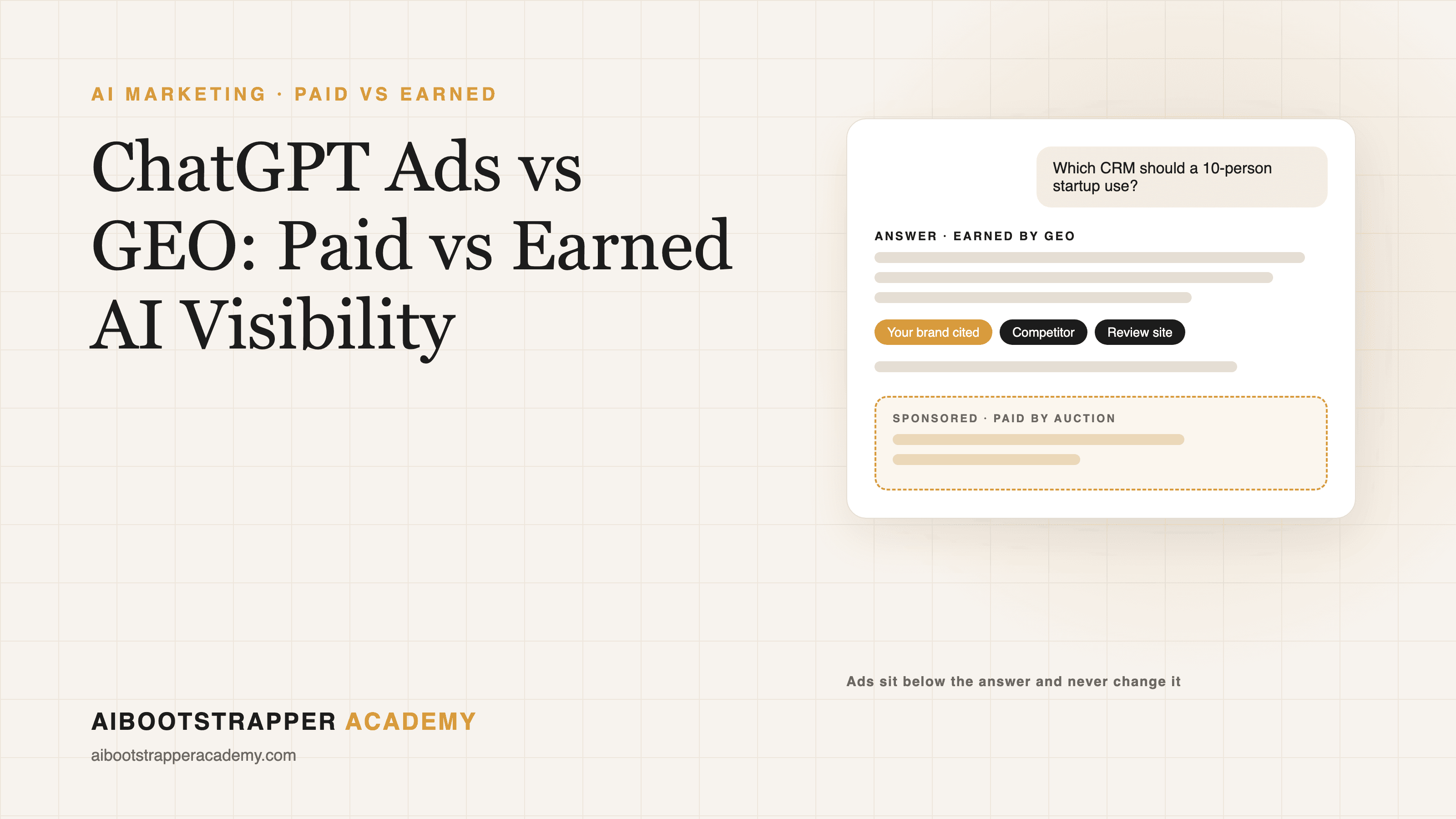
ChatGPT Ads now run in 60+ countries, but they sit below the answer, never change it, and never reach Plus, Pro, Business or Enterprise users. Here is how the ad system works and how to split budget between paid and earned AI visibility.
ChatGPT now sells ads, and the question I keep getting from founders and marketing leads is the obvious one: if I can pay to appear in ChatGPT, do I still need to work on getting cited? The short answer is yes, because the two things live in different places on the screen, reach different users, and run on different systems. Paying for one does not buy you the other. Here is how ChatGPT Ads actually work, based on OpenAI's own documentation, and how to decide where your budget and effort go.
What ChatGPT Ads are, in one paragraph
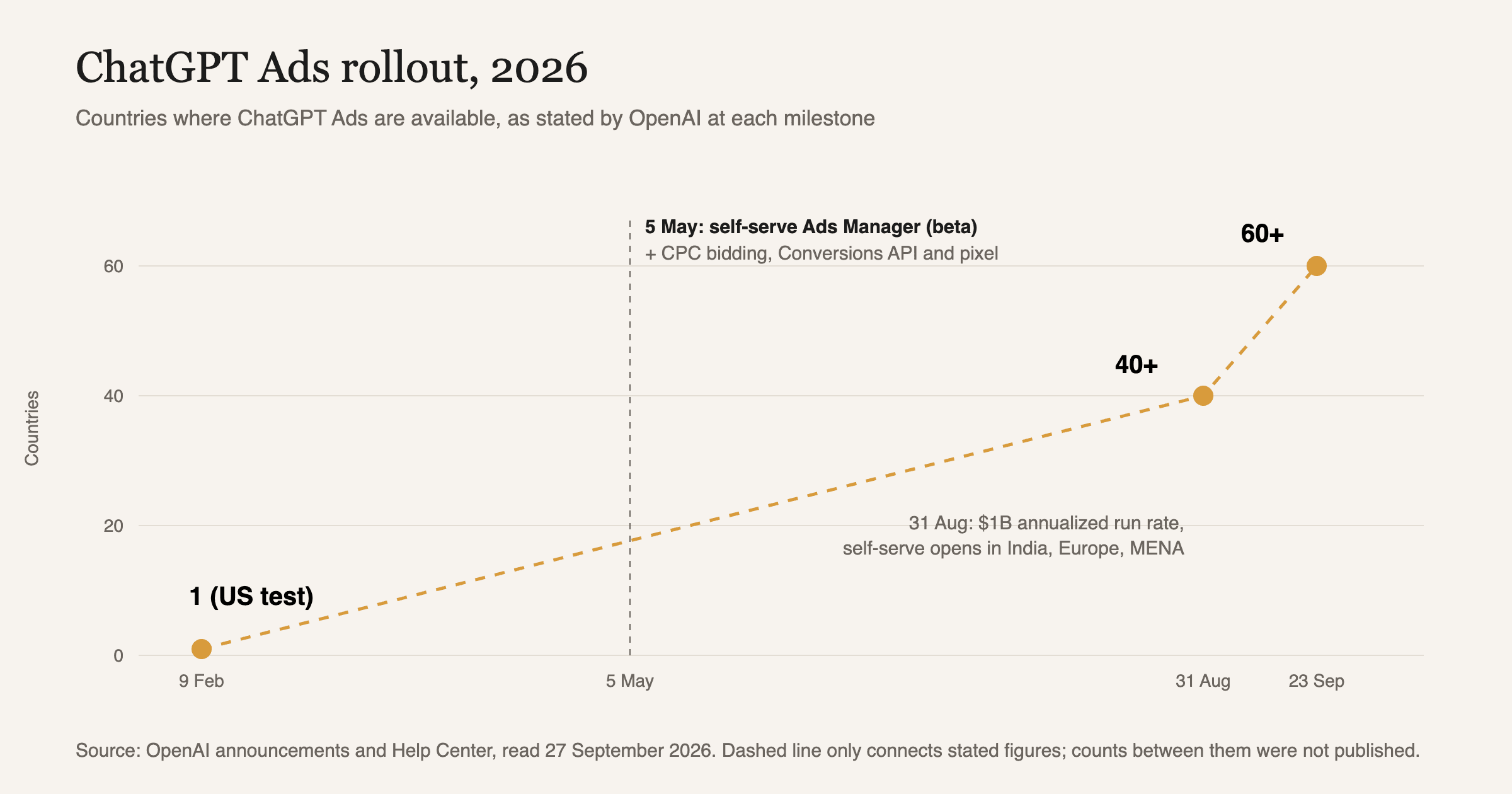
OpenAI began testing ads in the US on 9 February 2026, according to its Ads in ChatGPT help article. On 5 May 2026 it opened a beta self-serve Ads Manager and added cost-per-click bidding alongside the original CPM buying, plus Conversions API and pixel measurement (OpenAI, New ways to buy ChatGPT ads). On 31 August 2026 OpenAI said the ads business had passed a $1 billion annualized revenue run rate in under 200 days, was available in over 40 countries, and was opening self-serve buying across India, Europe, the Middle East and North Africa (OpenAI, A milestone in expanding access to AI). On 23 September 2026 it added seven Asian markets and put the total above 60 countries (OpenAI, Southeast Asia and Taiwan).
The mechanism: how an ad gets chosen
The detail that matters most for strategy is that the ad system and the answer model are separate. OpenAI's help article states that ads "run on separate systems from our chat model" and that advertisers cannot shape, rank or alter responses. Ads appear below the end of a response, labeled as sponsored and visually separated from the answer.
Selection works on context rather than classic demographic targeting. Per the same help page, the system weighs the context and intent of the current conversation, the ad's landing page, title and copy, advertiser-provided context hints and targeting selections, and, only when a user has ads personalization on, select signals from their broader ChatGPT use such as past chats and memory. When several ads are eligible, ranking combines relevance and bid. Your landing page is therefore an input to matching, not just the destination after a click, which is a real difference from search ads where the keyword does most of the work.
A few hard exclusions shape what you can and cannot buy:
- Ads only show on the Free and Go plans. Plus, Pro, Business, Enterprise and Edu accounts see no ads.
- No ads for accounts identified as under 18, and none in Temporary Chats.
- Ads are not eligible near sensitive topics such as personal health, mental health or politics, and political advertising is not allowed.
- Personalized ads are not initially available in the EEA or Switzerland, so ads there rely on the current conversation only.
- Advertisers get aggregated performance data such as views and clicks, never the chats themselves.
Why ads do not replace GEO
Put those facts together and the gap is clear. The answer is the part people read and trust, and OpenAI states plainly that money does not influence it. If ChatGPT recommends three tools in its answer and you are not one of them, your sponsored card sits underneath a response that has already framed the decision without you. Earning a place inside the answer is what generative engine optimization is for, and it works through the content, mentions and structure the model retrieves, not through an auction.
The plan exclusion matters even more for B2B. Anyone using ChatGPT through a Business or Enterprise workspace, or a paid Plus or Pro plan, will never see your ad. For many B2B categories, those paid users are the very buyers you most want, so for them earned citations are the only way into ChatGPT at all. Ads also only reach ChatGPT; your citations work across Perplexity, Gemini, Claude and Google's AI features too.
The reverse is also true, and worth being honest about. GEO is slow and uncertain. You cannot guarantee a citation, and our write-up on why most websites rarely get cited by AI search shows how concentrated citations are. Ads give you something GEO cannot: guaranteed placement on a specific type of conversation, starting this week, with a budget you control.
A practical way to split the decision
Here is how I would think about it for a small team:
- Consumer or SMB offer, clear purchase intent, free-tier audience: test ads. Start with CPC so you pay only for clicks, which OpenAI says now covers the majority of campaigns alongside outcome-optimized bidding.
- B2B offer sold to people who use ChatGPT at work on paid plans: prioritize GEO. Ads cannot reach that audience.
- Regulated or sensitive category (health, some financial topics): check eligibility first. Ads may be restricted, so earned visibility carries more weight.
- EU-heavy audience: expect contextual-only matching, which makes landing-page and context-hint quality even more important.
- Everyone: do both in sequence. Use a small ad test to learn which conversation contexts convert, then build content that earns citations for those same questions.
Measure it with tools you control
Ads Manager reports on its own delivery, and like any platform it grades its own homework. Tag ad landing pages with UTM parameters and track them in your own analytics so you can compare paid ChatGPT traffic with the organic AI referral traffic you already get. Free, open-source options work well here: Plausible (docs), Umami (docs), Matomo (docs) and PostHog can all be self-hosted. Our guide to tracking AI search traffic in GA4 versus server logs covers separating organic AI referrals so you are not double-counting.
One caution: OpenAI has published only its own success examples so far, such as an ecommerce advertiser with 3x return on ad spend over 28 days. That is a vendor case study, not a benchmark. Run your own small test before committing real budget.
Going deeper
This post covers the mechanics and the decision. Running both channels well means building content that AI engines actually retrieve, choosing which questions to own, writing landing pages that match conversational intent, and measuring paid and earned AI traffic side by side. That is the core of The AI Marketing Engine, which goes past the overview here into building a GEO program and connecting it to paid AI channels as they mature.
Go deeper
The AI Marketing Engine
Want the full The AI Marketing Engine course, not just this post?
Join the waitlist and get a 20% launch discount the moment we open checkout. No payment now.
Taught by Aditya Jha · 40+ AI products shipped for real clients. No spam, unsubscribe any time.
Or join our free community for AI tips while you wait
One email a week: the AI tools, tactics, and course drops actually worth your time. No spam, unsubscribe anytime.
Questions about this or which course fits? Email academy@aibootstrapper.com and we'll answer it directly, not with a support ticket.