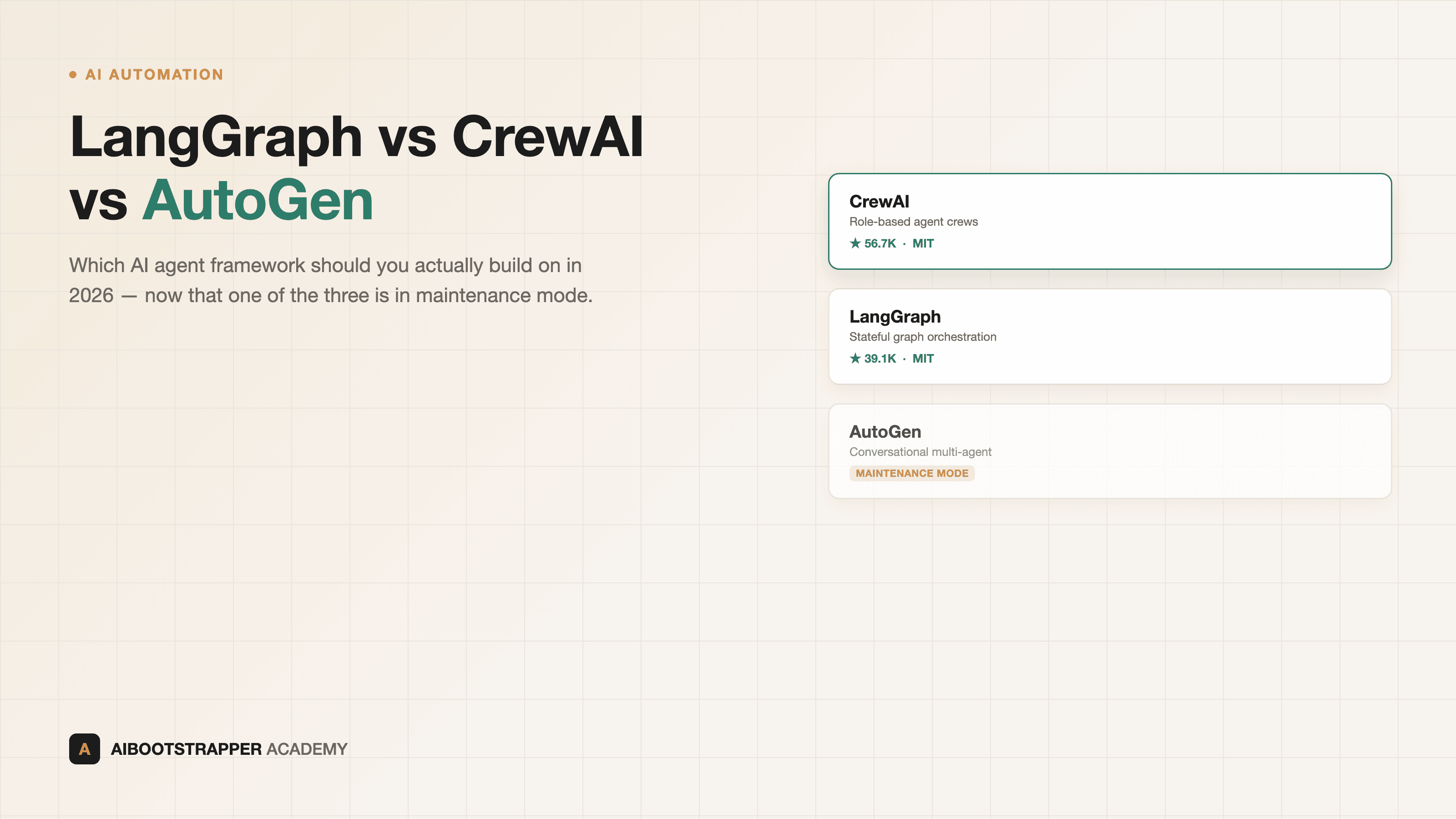
LangGraph vs CrewAI vs AutoGen: How to Actually Pick an AI Agent Framework in 2026
AutoGen is now officially in maintenance mode, CrewAI just passed LangGraph in GitHub stars, and Microsoft shipped an entirely new successor framework. Here is how the three actually differ under the hood, and how to pick without building on something already past its shelf life.
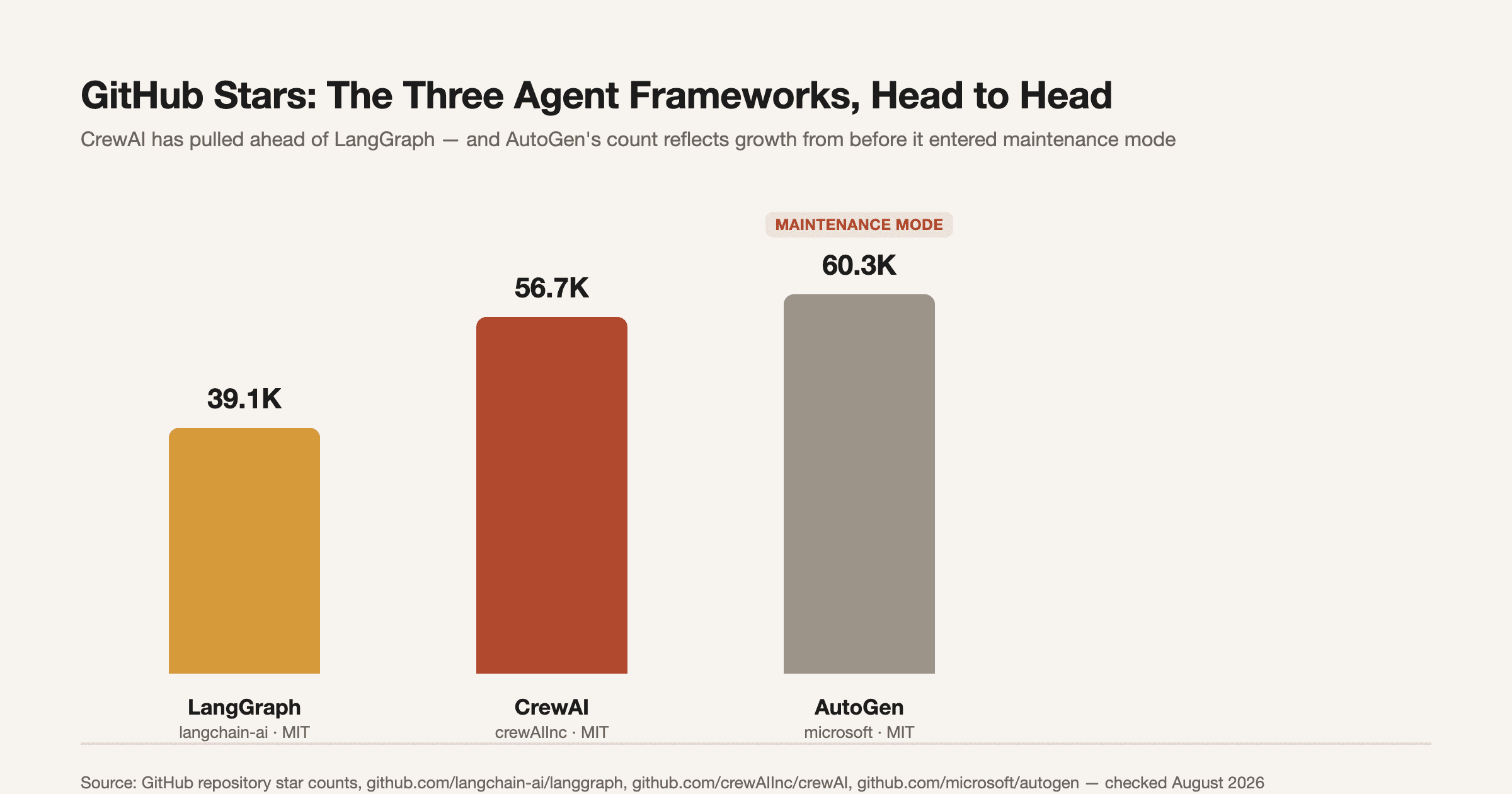
Search "AutoGen tutorial" today and the first thing you'll see on the official repo is a banner: "⚠️ Maintenance Mode: AutoGen is now in maintenance mode. It will not receive new features or enhancements and is community managed going forward." That's a real problem if you picked AutoGen eight months ago because a blog post told you to. Meanwhile CrewAI just passed LangGraph in GitHub stars, and Microsoft quietly shipped a completely different framework as AutoGen's actual successor. Here's what each of these three actually does under the hood, and how to pick without getting burned by a framework that's already past its shelf life.
Why you need an orchestration framework at all
A single LLM call that returns text isn't an agent. An agent needs a loop: call the model, let it decide whether to call a tool, execute that tool, feed the result back in, and repeat until the task is done or it gives up. You can hand-write that loop in about 40 lines of Python, and plenty of people do for a single-tool agent. It stops working once you need more than one: state that has to survive across dozens of tool calls, multiple agents that hand work to each other, a human who needs to approve a step before it fires, or a crash halfway through a task that shouldn't mean starting over. That's the actual problem these frameworks solve, and it's also why picking the wrong one costs you a rewrite, not just a swapped import.
LangGraph: agents as an explicit state machine
LangGraph (MIT license, 39.1K GitHub stars) models an agent as a directed graph: nodes are steps, edges are the possible transitions between them, and a shared state object gets passed and mutated as execution moves through the graph. That sounds heavier than it needs to be for a simple agent, and it is, but the payoff shows up the moment something goes wrong. LangGraph checkpoints state after every node, so a crash mid-task resumes from the last checkpoint instead of from zero, and you can pause execution at any node to insert a human approval step before the graph continues. LangChain's own production page lists Klarna, Uber, LinkedIn, and Elastic as users, which tracks with what it's built for: long-running, multi-step workflows where "the agent silently did the wrong thing three steps ago" is not an acceptable failure mode.
CrewAI: agents as a role-based team
CrewAI (MIT license, 56.7K GitHub stars, now ahead of LangGraph) starts from a different metaphor: instead of a graph, you define Agents with roles ("Research Analyst," "Content Editor"), give each one Tasks, and assemble them into a Crew that runs sequentially or in parallel. It's a genuinely faster way to get a multi-agent workflow running because the abstraction maps directly onto how you'd describe the job to a new hire, which is also why it's become the default answer to "how do I get three agents talking to each other" in tutorials. The tradeoff is the same one every higher-level abstraction makes: less control over exactly how state flows between agents, and less visibility when a crew produces a wrong answer and you need to know which agent's output caused it. CrewAI's newer "Flows" feature exists specifically to claw back some of that deterministic control for teams that outgrow the pure role-based model.
AutoGen is not the third option anymore
For most of 2025, "LangGraph vs CrewAI vs AutoGen" was a fair three-way comparison. It isn't anymore. Microsoft merged AutoGen's conversational multi-agent research with Semantic Kernel's enterprise plugin system into a single new SDK, Microsoft Agent Framework, which shipped as 1.0 for Python and .NET on April 3, 2026 with stable APIs and a long-term support commitment. AutoGen's own repository now tells new users to start with Agent Framework instead and points existing users to a migration guide. If you're picking a framework today, "AutoGen" should really read as "Microsoft Agent Framework" in your head, especially if you're already on Azure or building in .NET, where it's the natural fit.
How to actually decide
- **Need reliability, resumable state, and a human-in-the-loop approval step for a long or high-stakes workflow?** Pick LangGraph. The checkpointing and explicit graph structure are built for exactly this, and it's the one with named enterprise users running it in production.
- **Need to stand up a multi-agent workflow fast, and the failure mode of "slightly wrong output" is recoverable, not catastrophic?** Pick CrewAI. The role-based model gets you from zero to working demo faster than anything else here.
- **Already building on Azure, .NET, or need enterprise plugin connectors out of the box?** Pick Microsoft Agent Framework, not AutoGen. Same lineage, actively developed, with a real migration path if you're already on either predecessor.
- **Building a browser-specific agent, not a general orchestration layer?** None of the three above are the right tool. browser-use (MIT, 108K+ stars) is a purpose-built library for giving an LLM control of a browser, and it composes with any of the frameworks above rather than replacing them.
When you don't need a framework at all
The honest answer for a lot of automations is: skip the framework entirely. If your "agent" is one trigger, one LLM call, and one action, a full graph-based orchestration layer is solving a problem you don't have. That's the territory covered in our n8n vs Zapier vs Make comparison — visual workflow tools handle single-agent, single-tool automations with far less code, and they're often the right starting point before you reach for LangGraph or CrewAI at all. Once your agent needs to call other agents or tools dynamically rather than following a fixed workflow, that's usually the signal you've outgrown the no-code layer and it's time to look at MCP for standardizing how those tool calls happen, on top of whichever orchestration framework you pick. Our AI Automation Mastery course walks through building both layers end to end, from a single n8n workflow up through a multi-agent LangGraph pipeline with real tool integrations.
Go deeper
AI Automation Mastery
Want the full AI Automation Mastery course, not just this post?
Join the waitlist and get a 20% launch discount the moment we open checkout. No payment now.
Taught by Aditya Jha · 40+ AI products shipped for real clients. No spam, unsubscribe any time.
Or join our free community for AI tips while you wait
One email a week: the AI tools, tactics, and course drops actually worth your time. No spam, unsubscribe anytime.
Questions about this or which course fits? Email academy@aibootstrapper.com and we'll answer it directly, not with a support ticket.