Query Fan-Out in Google AI Mode: How to Structure Content So It Gets Retrieved
Google AI Mode turns one question into many parallel searches. Here is what that mechanism means for how you structure pages, what Google itself says you do not need, and how to measure it.
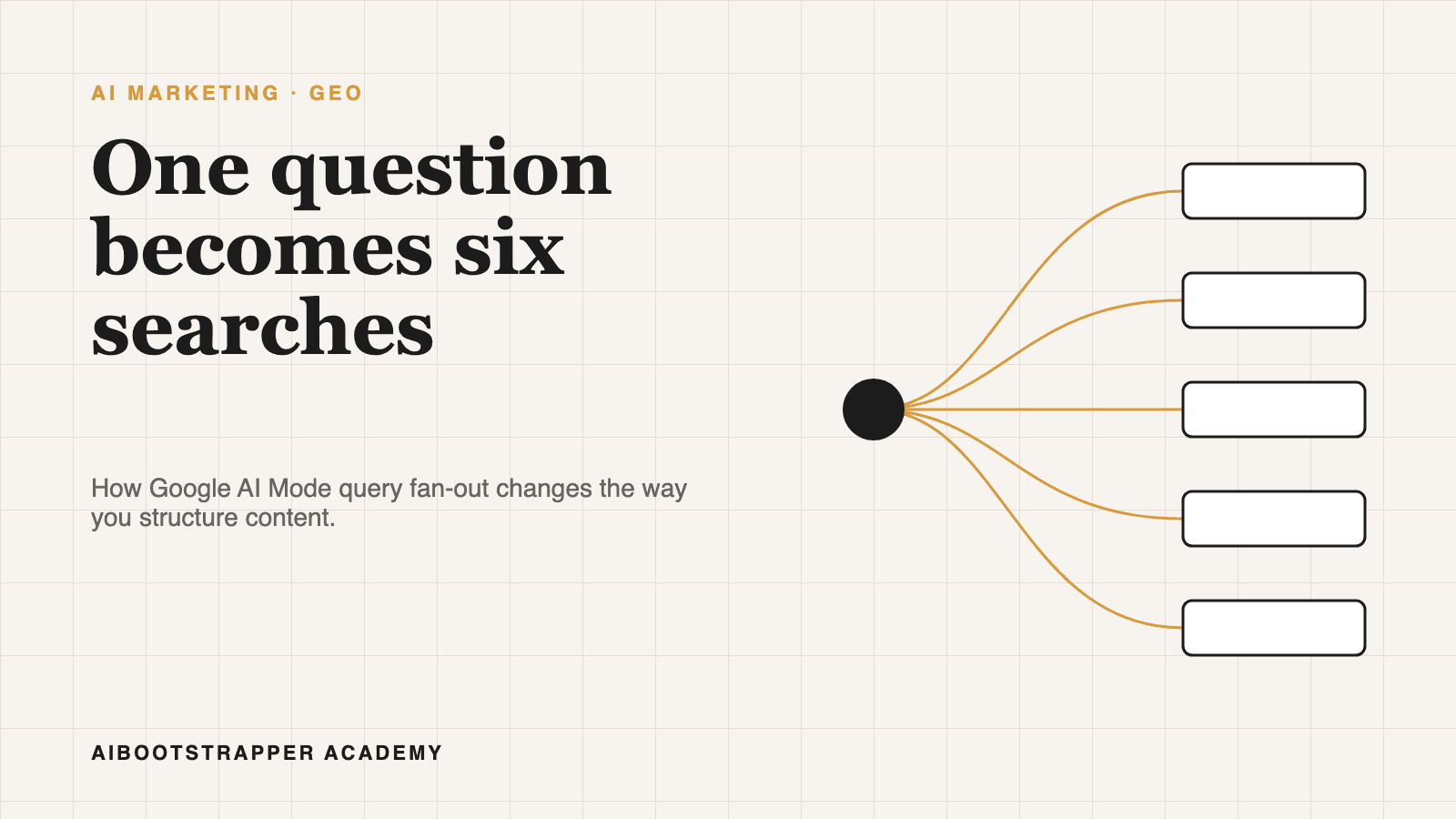
When someone types a complex question into Google AI Mode, Google does not run one search. It runs several, in parallel, then stitches the results into one answer. That mechanism is called query fan-out, and it changes what "ranking" means for a page. This post explains how it works, what Google itself says you need to do (less than most GEO vendors claim), and how to structure content so that each sub-query can find a passage worth citing.
What query fan-out actually is
Google's own documentation says AI Overviews and AI Mode "may use" query fan-out, issuing multiple related searches across subtopics and data sources while generating a response. See Google's page on AI features and your website. Coverage of an interview with Google's search product lead describes the system as using Google Search as a backend tool: it runs many queries and merges what comes back into one linked response (Search Engine Journal).
Think of it as a retrieval step in front of a language model. A question like "best way to automate lead follow-up for a 5-person agency" is decomposed into sub-questions (which tools, what it costs, how to avoid spam flags, what a workflow looks like). Each sub-question is its own retrieval. Pages are no longer competing for one head term; they compete for individual sub-queries, and the model then synthesizes whatever it retrieved. Aleyda Solis's write-up also notes that simple factual questions tend to trigger little or no fan-out, so this matters mostly for complex, multi-part queries.
What Google says you do not need
This is the part worth reading carefully, because a lot of GEO advice sells complexity. Google's documentation states that a page must be indexed and eligible to show with a snippet, and that there are no additional technical requirements. It says site owners do not need new machine-readable files, AI text files, or special schema.org markup. The page does not mention llms.txt at all. We looked at that file separately in does llms.txt actually get you cited by AI.
The honest reading: the foundation is classic SEO (crawlable, indexed, useful). Fan-out raises the bar on coverage and clarity, not on exotic markup.
Structure content for sub-queries, not one keyword
If retrieval happens per sub-question, a page that answers the whole topic in one undifferentiated block is harder to retrieve from than one with clearly separable answers. Practical structure:
- **One question per heading.** Phrase H2s as the sub-question a buyer would ask ("How much does it cost?", "What breaks first?").
- **Answer first.** Put the direct answer in the first one or two sentences under the heading, then the nuance.
- **Make passages self-contained.** A retrieved paragraph is read out of context, so name the subject explicitly instead of saying "it" or "this approach".
- **Use tables for comparisons.** Tool-versus-tool questions are classic fan-out branches; a table makes each cell extractable.
- **State limits.** Including when your recommendation does not apply makes a passage more trustworthy to cite, and to a human reader.
To find the sub-questions, ask the AI tools themselves the question your customer would ask, read which follow-ups they cover, and check the "People also ask" and related-search blocks. That is inference, not a published list, so treat it as a hypothesis to test.
The spam line: do not build a page per variation
It is tempting to publish a separate thin page for every conceivable sub-query. Secondary reporting on Google's guidance says doing this to manipulate rankings or AI responses runs into its spam policy. A better pattern is one thorough page with clear sections, plus separate pages only where the intent is truly different. Our related post on why your website rarely gets cited by AI search covers the usual reasons pages are skipped.
How to measure it
Google says AI Overviews and AI Mode traffic is counted in the Search Console Performance report under the Web search type, and suggests tracking conversions and time on site in analytics. That means there is no separate AI Mode report: you will not see a clean split inside Search Console. For other assistants, see tracking AI search traffic with GA4.
Controls also matter. `nosnippet`, `data-nosnippet`, `max-snippet` and `noindex` limit what appears in Search, including AI features, so check you have not set them by accident. If controls seem ignored, use URL Inspection to see the HTML Googlebot actually received, and allow time for a recrawl.
Tradeoffs and what we do not know
Google does not publish how many sub-queries a given question spawns or how it weights the retrieved passages, so any claim of an exact "fan-out count" for your niche is guesswork. Fan-out behaviour also varies by engine; ChatGPT and Perplexity retrieve differently, so optimizing only for Google is a bet, not a strategy. Treat structural improvements as cheap, low-regret changes and measure outcomes in your own data.
Where to go deeper
This post introduces the mechanism. If you want to turn it into a repeatable system (auditing which sub-questions your buyers ask, restructuring existing pages, building the measurement stack across Google, ChatGPT and Perplexity), that is exactly what The AI Marketing Engine walks through step by step. For a comparison of what GEO training actually teaches, see best GEO courses in 2026.
Go deeper
The AI Marketing Engine
Want the full The AI Marketing Engine course, not just this post?
Join the waitlist and get a 20% launch discount the moment we open checkout. No payment now.
Taught by Aditya Jha · 40+ AI products shipped for real clients. No spam, unsubscribe any time.
Or join our free community for AI tips while you wait
One email a week: the AI tools, tactics, and course drops actually worth your time. No spam, unsubscribe anytime.
Questions about this or which course fits? Email academy@aibootstrapper.com and we'll answer it directly, not with a support ticket.