Why Ranking #1 on Google Still Decides Who ChatGPT Cites
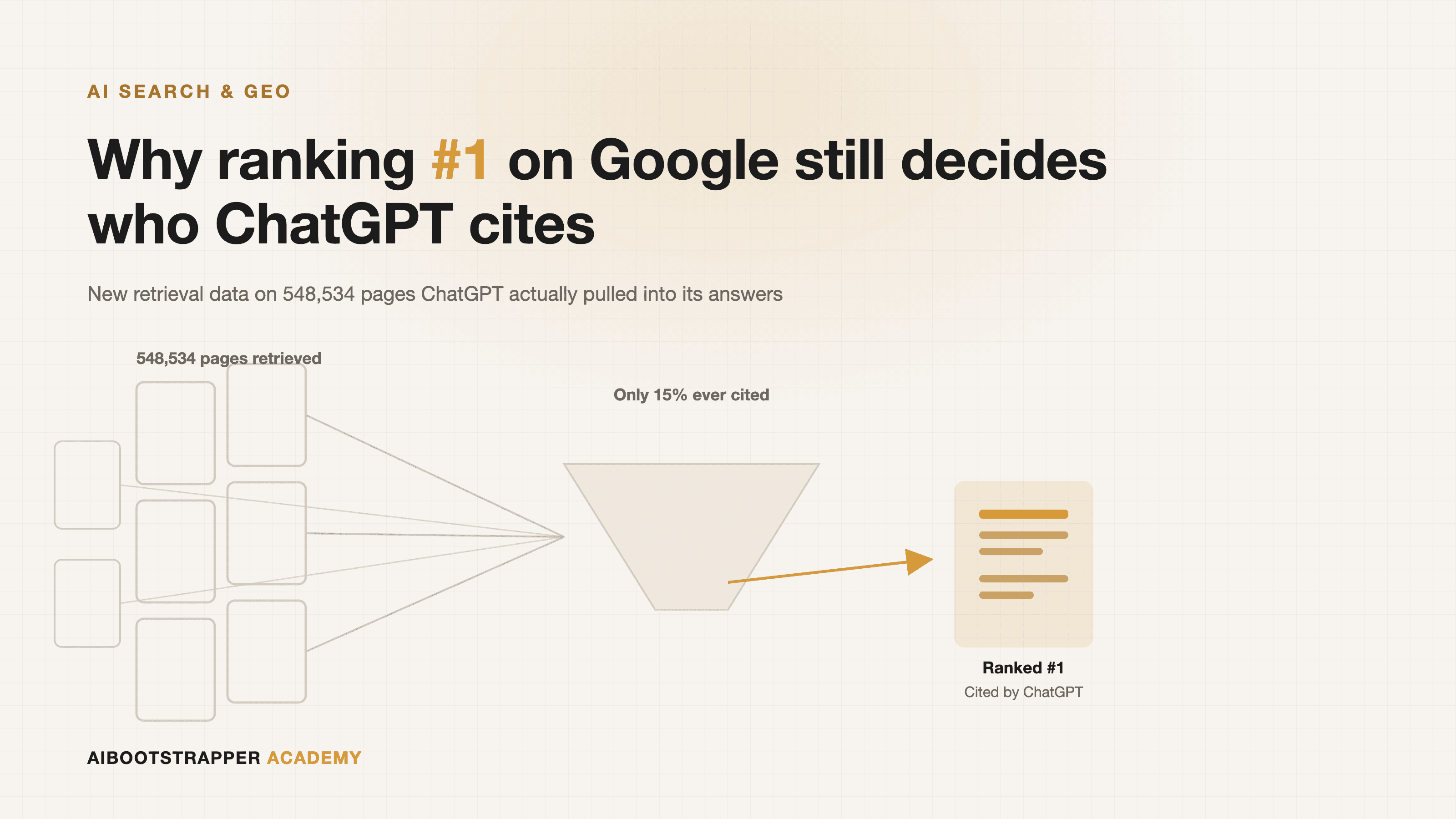
New AirOps data on 548,534 retrieved pages shows ChatGPT cites only 15% of what it retrieves, and Google's #1 ranking spot is still the single biggest predictor of which 15%.
"SEO is dead" has been said every year since AI Overviews launched, and every year the data says something more specific and more useful: search isn't dead, but the reward for ranking has moved from clicks to citations. Two studies published in the last year, one from Pew Research Center and one from AirOps, show exactly how that shift works mechanically, and the second one has an answer to a question a lot of marketers are getting wrong: if AI Overviews are killing clicks, does ranking on Google even matter anymore for AI search? The data says yes, more than most people think, just for a different reason than before.
The zero-click reality is real, and it's not close
Pew Research Center tracked the actual browsing behavior of 900 U.S. adults for the month of March 2025, capturing 68,879 real Google searches, 12,593 of which triggered an AI-generated summary. The full study is worth reading directly rather than through a secondhand summary, because the numbers are stark: users clicked a traditional search result in just 8% of visits when an AI summary appeared, compared to 15% when it didn't, almost double. Only 1% of visits resulted in a click on one of the sources cited inside the summary itself. People who did land on a page after seeing a summary were also more likely to leave immediately, a 26% abandonment rate versus 16% without a summary.
That's the case for "SEO is dead." What it misses is that 18% of searches produced a summary at all in Pew's sample, meaning 82% of searches still worked exactly the way they always did. And on the 18% where an AI answer engine is genuinely mediating the interaction, the game didn't disappear, it changed shape: instead of competing to be clicked, you're competing to be the source the model actually quotes.
How ChatGPT actually decides who to cite
This is the part most GEO advice skips, because it requires the kind of large-scale, systematic study almost nobody runs. AirOps built one. Their report, The Influence of Retrieval, Fan-out, and Google SERPs on ChatGPT Citations, ran 15,000 original queries across 8 intent categories (informational types like definition and how-to, commercial types like comparison and validation), let ChatGPT's fan-out behavior expand those into 43,233 total queries, and tracked all 548,534 pages the model actually retrieved during research.
The headline number: only 15% of retrieved pages made it into ChatGPT's final answer. The other 85% were pulled into context, evaluated, and silently discarded. This is the mechanism that matters for anyone doing GEO work: ChatGPT isn't picking sources from the open web at query time, it's picking from a retrieval set it already assembled, and being retrieved is necessary but nowhere close to sufficient. Getting indexed, or even getting pulled into that 548,534-page retrieval pool, only gets you to the starting line.
Ranking position still runs the table
Here's the finding that should end the "Google ranking doesn't matter for AI search" argument. Within that retrieval pool, AirOps found pages ranking #1 on Google for the underlying query were cited 43.2% of the time. Pages ranking beyond position 20 were cited at roughly 12.3%, a 3.5x gap. Zoomed out further, 55.8% of every page ChatGPT ever cited across the entire study ranked somewhere in Google's top 20 for at least one of the queries involved.
That's a striking number given ChatGPT is not Google and doesn't use Google's ranking algorithm directly. What it suggests is that Google's ranking signals and the signals ChatGPT's retrieval and reasoning layer respond to overlap heavily, both are proxies for the same underlying thing: is this page a genuinely strong, well-structured, trusted answer to this specific query. Traditional SEO work, the kind covered in our GEO vs SEO breakdown, isn't obsolete. It's now doing double duty as an input to a second selection process layered on top of it.
What separates cited pages once they're in the pool
Rank isn't the only lever. AirOps also measured title-to-query word overlap: pages with 50% or more of their title words matching the query language were cited 20.1% of the time, versus 9.3% for pages with less than 10% overlap, a 2.2x difference. That's a mechanical, checkable thing you can fix in an afternoon: does your H1 and title tag actually contain the words a person would type or ask, not just a clever rebrand of them.
Domain authority mattered too, but not in the way most people assume. Pages in the DA 40-80 band accounted for 63.6% of all citations, more than double the share of either the DA 20-40 band (26.0%) or the DA 80-100 band (25.4%) alone. The takeaway isn't "you need to be a massive authority site to get cited." It's closer to the opposite: once a domain clears a credibility threshold, being the most specific, best-matched answer to the query matters more than being the biggest name in the room. This tracks with why generic schema markup doesn't move citation rates the way a lot of SEO advice claims, structured data can't manufacture query-match relevance that isn't in the actual content.
Query type changes your odds before you write a word
The study also broke citation rates down by the eight intent categories, and the spread is wide enough to change what you prioritize. Product-discovery queries had the highest citation rate at 18.3%, followed by how-to content at 16.9%. Comparison queries dropped to 13.1%, and validation queries, the "is X actually true" or "does Y really work" type, were lowest at 11.3%.
If you're deciding what to write next, a specific how-to or product-comparison piece with a clear, well-matched title has a meaningfully better shot at citation than a broad validation-style post, even before you touch quality or structure. This is also why we teach founders in The AI Marketing Engine to map content to the actual intent category before writing, not after.
What this actually changes about your content plan
Put the two studies together and the strategy gets concrete instead of vague:
- Keep ranking on Google. It isn't a separate channel from AI search anymore, it's the retrieval filter that decides whether ChatGPT ever sees your page at all, and a strong predictor of whether it gets cited once retrieved.
- Match your titles and headings to the literal language of the query, not a stylized version of it. The 2.2x gap between high and low title-overlap pages is one of the few citation levers you can act on directly, this week.
- Prioritize how-to and product-discovery formats over broad validation or opinion pieces when you're choosing what to publish next, the baseline odds are meaningfully better before you've written a word.
- Don't chase schema markup or authority-building as a shortcut. Neither one substitutes for being the page that most precisely answers the question being asked, which is what both studies ultimately measured.
- Accept that being retrieved isn't being cited. If you're tracking whether your content shows up in ChatGPT, track actual citations, not indexing or crawl activity, since 85% of what gets pulled in never makes the final answer.
Zero-click search is real, and it's not going away. But "AI killed SEO" and "ranking #1 gets you cited 3.5x more often than page two of Google" are both true at the same time, they're just describing two different parts of the same funnel. The work moved. It didn't disappear.
Go deeper
The AI Marketing Engine
Want the full The AI Marketing Engine course, not just this post?
Join the waitlist and get a 20% launch discount the moment we open checkout. No payment now.
Taught by Aditya Jha · 40+ AI products shipped for real clients. No spam, unsubscribe any time.
Or join our free community for AI tips while you wait
One email a week: the AI tools, tactics, and course drops actually worth your time. No spam, unsubscribe anytime.
Questions about this or which course fits? Email academy@aibootstrapper.com and we'll answer it directly, not with a support ticket.