When to Fine-Tune an LLM Instead of Using RAG: A QLoRA and Unsloth Cost Breakdown
Fine-tuning an open-source model now costs under $5 in GPU time, but that doesn't mean it's the right tool for your problem. Here's the actual mechanism, the real 2026 costs, and when RAG still wins.
Most teams reach for fine-tuning the moment a model gets something wrong, and most of the time that's the wrong move. Fine-tuning is the slowest, most expensive lever in the toolbox, and it solves a narrower problem than people expect: it changes how a model behaves, not what it knows. If your model is giving wrong answers because it doesn't have the right facts, fine-tuning won't fix that - you need retrieval. If it's giving wrong answers because it won't follow your output format, your tone, or a house style no matter how you phrase the prompt, that's the one case fine-tuning is actually built for. The good news in 2026 is that if you do need it, it no longer requires a training cluster - a single consumer GPU and an afternoon will get you there.
Fine-tuning changes the weights, not the prompt
Prompt engineering and RAG both work by controlling what goes into the context window - the instructions, the retrieved documents, the examples. The model's weights never change. Fine-tuning is the opposite: you run backpropagation on the model itself, nudging its parameters so a behavior becomes the default instead of something you have to ask for every time. That's why fine-tuning is genuinely good at consistent formatting, tone, structured output schemas, and domain-specific reasoning patterns repeated across thousands of examples - and genuinely bad at injecting facts that change weekly, because every fact update means retraining. A RAG pipeline, by contrast, can swap in new knowledge the moment a document changes, with no training run at all.
The practical sequence most production teams converge on: start with prompt engineering because it costs an afternoon and no infrastructure, add RAG once outdated or missing knowledge is the actual bottleneck, and only fine-tune once you've confirmed the failure is behavioral rather than a knowledge gap - typically once you have 500 or more curated examples of the behavior you want.
Why LoRA and QLoRA made this affordable
Full fine-tuning means updating every one of a model's parameters, which is why the original LoRA paper describes a workaround: freeze the pretrained weights entirely and inject small trainable "rank decomposition" matrices into each transformer layer instead. You train only those tiny matrices - a few million parameters instead of billions - and merge them back in at inference time with no added latency. Hu et al.'s LoRA paper reports this cuts trainable parameters by 10,000x and GPU memory by 3x on GPT-3 175B, without giving up accuracy against full fine-tuning.
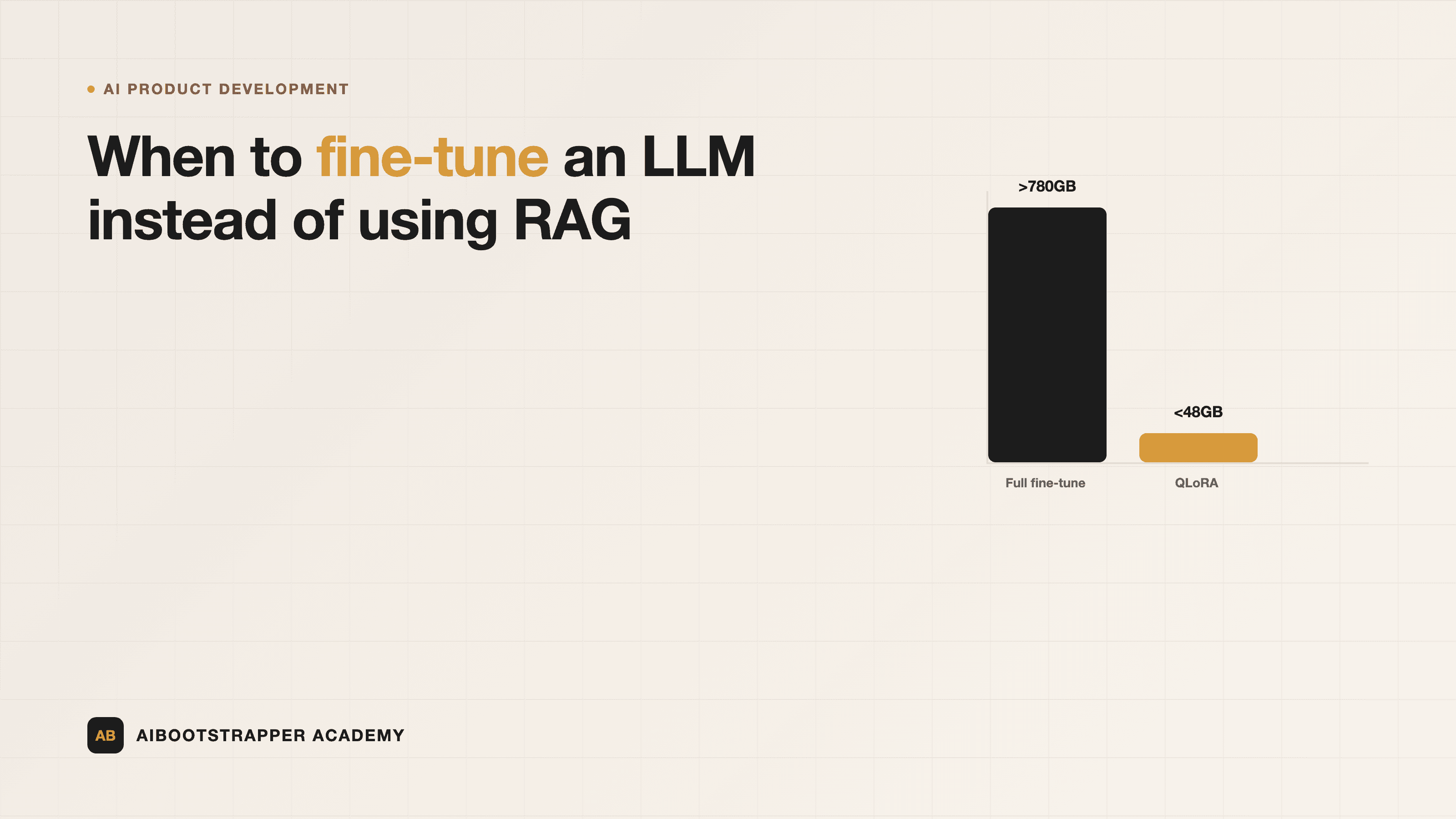
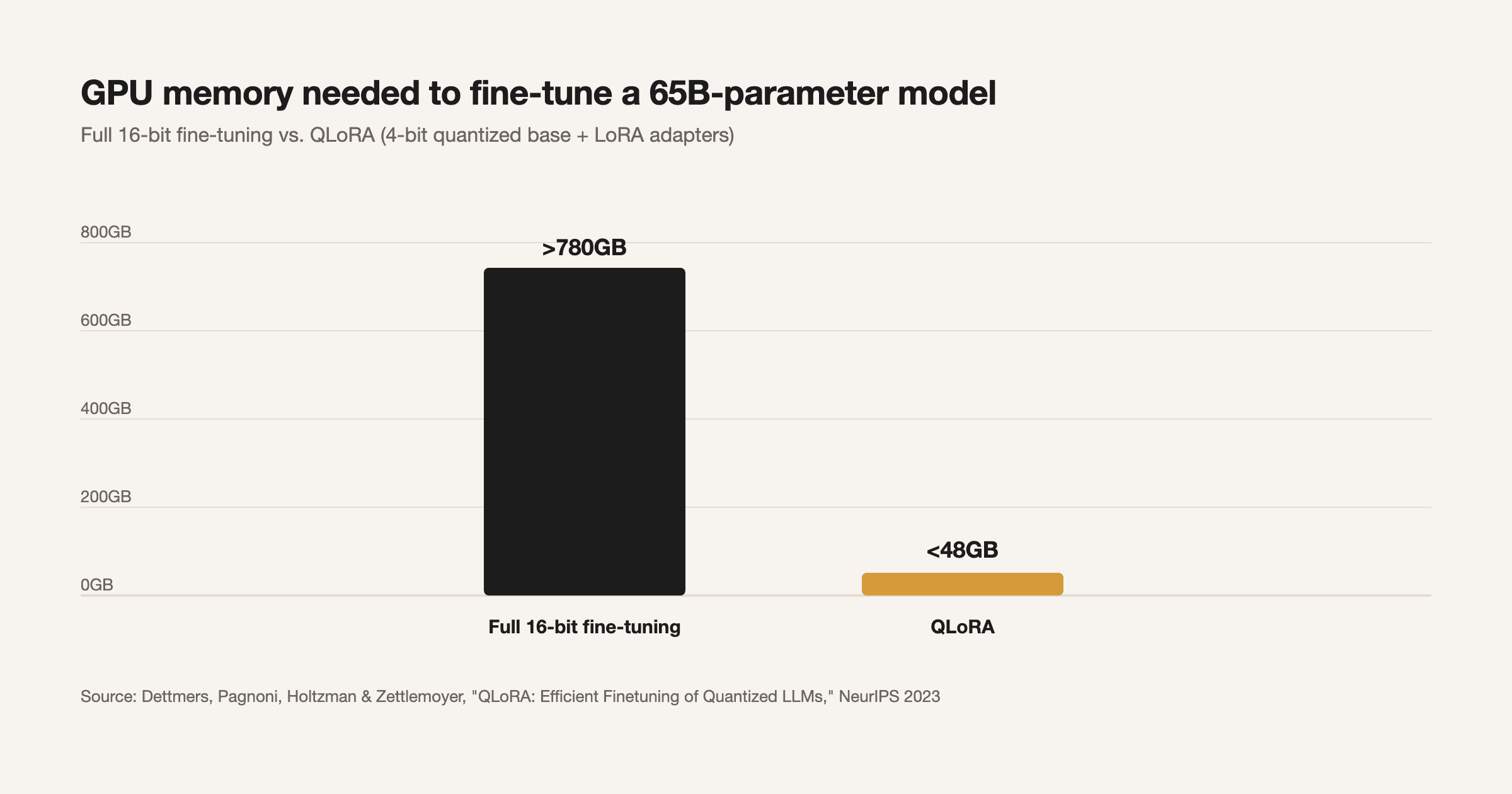
QLoRA pushes the same idea further by also compressing the frozen base model to 4-bit precision (a format called NF4) before attaching LoRA adapters on top, plus a technique called double quantization that shrinks the memory used by the quantization process itself. The headline number from the paper: QLoRA "reduces the average memory requirements of finetuning a 65B parameter model from >780GB of GPU memory to <48GB," according to Dettmers et al.'s QLoRA paper - without a measurable drop in output quality versus full 16-bit fine-tuning. That's the difference between needing a multi-GPU server rack and needing one workstation card.
What it actually costs to run in 2026
Unsloth, the open-source library most people now use to run QLoRA, rewrote the training kernels in Triton and claims - directly in its GitHub README - to "train LLMs, diffusion, TTS, and embedding models 2x faster with 70% less VRAM" than the stock Hugging Face stack, with no accuracy loss. In practice that means an 8B model that used to need a 40GB+ datacenter GPU now trains comfortably on a 12-16GB consumer card, and it's free to run locally if you already own the hardware.
If you don't, GPU rental makes the whole exercise cheap enough to experiment with. RunPod's published pricing lists RTX 4090 instances at $0.34/hr on its Community Cloud tier - a QLoRA run on a 7B-13B model over a few hundred examples typically finishes in one to three hours, putting the compute cost for a full fine-tuning experiment at well under $5. The real cost isn't the GPU-hour; it's the time spent building and cleaning a training set good enough to actually change the model's behavior, which is usually the majority of the project.
The open-source toolchain, not just Unsloth
Unsloth is the fastest way to get a single LoRA/QLoRA run working, but it's not the only serious option, and picking the right one depends on how much you want to hand-configure. Axolotl trades some of Unsloth's raw speed for YAML-driven configs that make it easier to reproduce a training run and swap datasets, which matters once you're iterating past a first experiment. Underneath both of them sits Hugging Face's PEFT library, the reference implementation of LoRA, QLoRA, and other parameter-efficient methods that most higher-level tools wrap. None of these require a paid API key or a cloud contract - the entire stack, from base model to training loop, can run on hardware you control, which is also why it pairs naturally with the open-source embedding models covered in an earlier post if your product needs both a fine-tuned generator and a retrieval layer.
The failure modes the quick-start tutorials skip
Two problems show up almost every time a first fine-tune goes wrong, and neither is a tooling issue. The first is catastrophic forgetting: hammer a model with a narrow dataset and it can lose general capabilities it had before, answering worse on tasks outside the training distribution even as it gets better on the target one. The second is overfitting on too little data - a few dozen examples can make a model repeat surface patterns from your training set (specific phrasings, example-specific quirks) instead of generalizing the underlying behavior, which is exactly why the 500-example threshold shows up so consistently as the practical floor. Neither failure is visible in training loss; you only catch them by holding out an evaluation set the model never trains on and checking it behaves correctly on inputs it hasn't memorized - the same evaluation discipline this blog covered when walking through how to evaluate a RAG pipeline, and just as necessary here.
Where this fits if you're building, not just experimenting
Running a single QLoRA job on a rented GPU is a good weekend project; deciding whether your product actually needs fine-tuning, RAG, both, or neither - and building the evaluation harness that tells you which one is working - is the harder, more valuable skill. That decision-making is the gap between a notebook that fine-tunes once and a product that stays correct after the tenth dataset update, and it's the part AI Product Development Bootcamp is built to close: the course goes from RAG fundamentals through evaluation metrics to exactly this kind of architecture decision, using the same open-source stack - PEFT, vector databases, real cost tradeoffs - rather than treating every problem as a prompt-engineering exercise. If you've read this far because you're stuck deciding between RAG and fine-tuning for something you're actually shipping, that's the reason to start there instead of a fourth blog post.
Go deeper
AI Product Development Bootcamp
Want the full AI Product Development Bootcamp course, not just this post?
Join the waitlist and get a 20% launch discount the moment we open checkout. No payment now.
Taught by Aditya Jha · 40+ AI products shipped for real clients. No spam, unsubscribe any time.
Or join our free community for AI tips while you wait
One email a week: the AI tools, tactics, and course drops actually worth your time. No spam, unsubscribe anytime.
Questions about this or which course fits? Email academy@aibootstrapper.com and we'll answer it directly, not with a support ticket.