How to Track AI Search Traffic: GA4's AI Assistant Channel vs. What Your Server Logs Actually Show
GA4 shipped a native AI Assistant channel in 2026, but it misses Perplexity and up to 70% of AI referral sessions land in Direct anyway. Here's what it actually measures, where it breaks, and how server logs and crawl data fill the rest.
Your Google Analytics dashboard says organic search traffic is flat, even though your brand keeps getting cited in ChatGPT answers and AI Overviews. Before concluding citations don't convert, check whether your analytics can even see them. For most sites, it can't, and that's not a setup mistake, it's a structural blind spot in how referrer-based analytics has always worked, one that AI search traffic exposes in a way old-fashioned Google clicks never did.
The traffic didn't disappear, it just stopped being visible
The stakes here are real. A Pew Research Center analysis of 68,879 real Google searches from a panel of 900 U.S. adults found that when an AI Overview appeared on the results page, people clicked a traditional search result only 8% of the time, compared to 15% when no AI summary was shown, and only 1% of visits went to a link inside the summary itself (Pew Research Center, July 2025). Ahrefs' own December 2025 data put the drop at the page level even higher: the presence of an AI Overview cut click-through to the top-ranking organic result by 58% (via Search Engine Land).
Some of that is a genuine loss, a reader got their answer without visiting anyone's site. But a meaningful slice is a visit that did happen, through a channel your analytics was never configured to recognize: a click from inside a ChatGPT or Perplexity answer, or a reader who arrived because an AI engine cited you. Misattribute that session and it looks identical to organic decline, so you make the wrong call on where to invest. This is also why who owns GEO inside a marketing org keeps coming up as an unresolved question: nobody wants to own a channel nobody can measure.
What GA4's new AI Assistant channel actually does
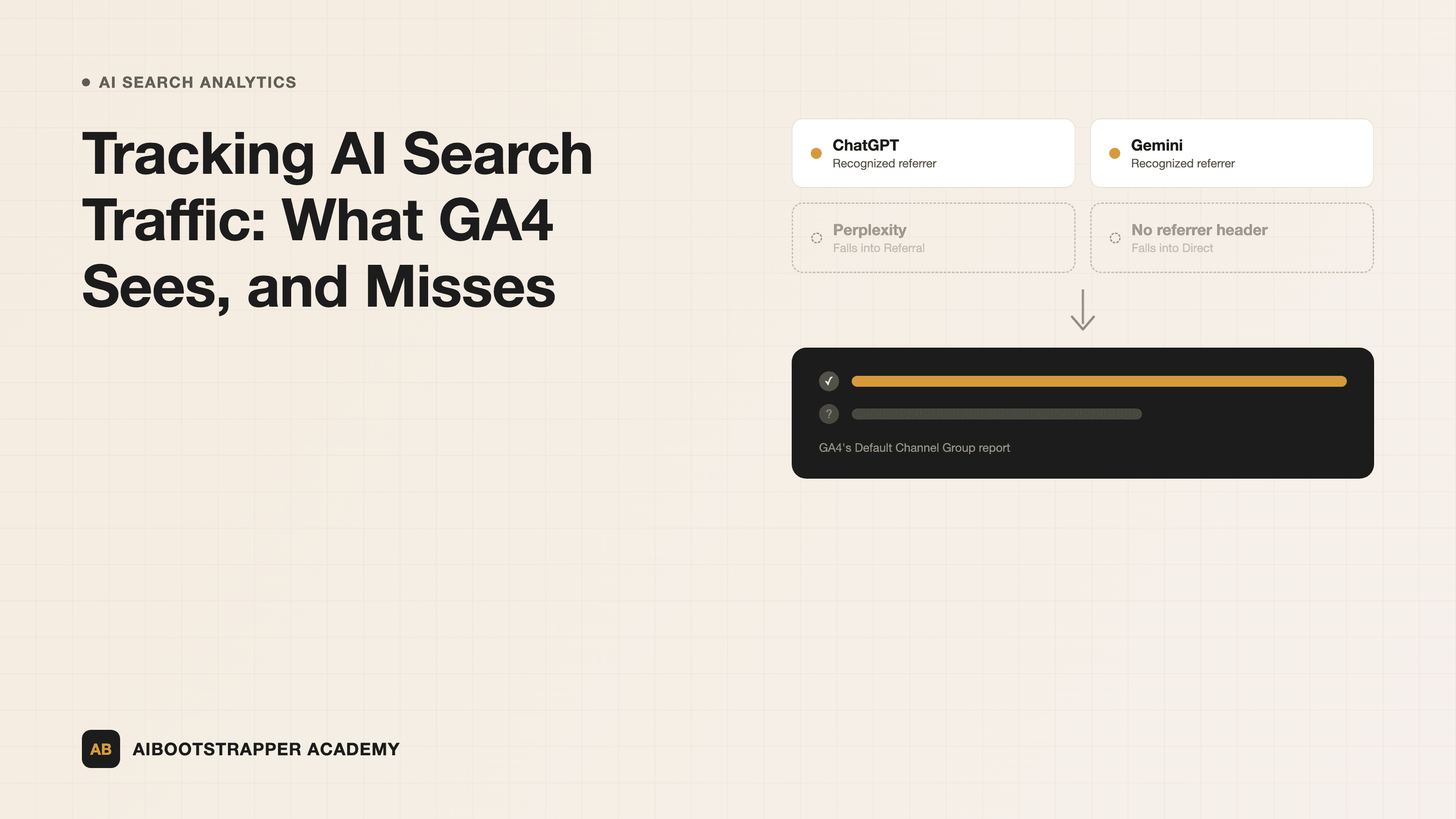
Google shipped a fix, of sorts. As of May 13, 2026, GA4's Default Channel Group report includes a native "AI Assistant" channel, confirmed in the platform's own What's New documentation (Google Analytics Help). Mechanically it's the same referrer-matching logic GA4 has always used to sort traffic into Organic Search, Referral, or Direct, just with a new list of recognized domains: when GA4 sees a referrer from a domain it recognizes, it sets the medium to `ai-assistant`, groups the session under the new channel, and tags the campaign as `(ai-assistant)`. Google names ChatGPT, Gemini, and Claude as the assistants it currently recognizes (Search Engine Journal). It requires no setup, which is exactly why you shouldn't assume it's complete.
Where the native channel breaks
Two gaps matter more than the feature announcement lets on.
- Perplexity isn't a recognized source. Sessions referred from Perplexity still land in plain Referral, mixed in with every other external link, not the AI Assistant channel, even though Perplexity is one of the highest-intent AI referral sources by volume.
- Referrer headers frequently never arrive at all. Many AI assistant apps, especially mobile apps and in-app browsers, strip or omit the referrer header for privacy reasons before the click reaches your site. When there's no referrer, GA4 has nothing to match against, so the session falls into Direct by default. Industry analyses of this specific pattern put the share of AI-referred sessions landing in Direct anywhere from roughly 35% to 70%, depending on platform and device mix (Conversios).
Neither gap is retroactive. GA4 processes this classification going forward only, so historical sessions stay misclassified exactly as they always were.
Fixing the gap: a custom channel group, ordered correctly
The fix isn't exotic: it's the same custom channel group feature GA4 has offered for years, pointed at the right sources. In Admin → Data Display → Channel Groups, define a rule matching source or referrer against a pattern like `chatgpt|openai|perplexity|gemini|claude|copilot`, alongside the native AI Assistant channel.
The detail that trips people up: GA4 evaluates channel group rules top to bottom and stops at the first match. If your custom AI rule sits below the default Referral rule, a Perplexity-referred session matches "Referral" first and never reaches it. Place the custom rule above Referral, not just above Direct. One breakdown of real AI referral volume by platform put the split at roughly 78% ChatGPT, 15% Perplexity, and 6% Gemini and others combined (Authority Tech), a reasonable order for which sources to catch first.
The traffic you'll never see in GA4 at all: crawlers, not visitors
Referral and Direct sessions are half the picture. The other half happens before any human ever clicks: AI crawlers fetching your pages to build the answer in the first place, and that traffic never touches your analytics tag, because no browser session is created.
Separate two kinds of bots by mechanism. Training crawlers like GPTBot, Google-Extended, and ClaudeBot fetch pages on a slow, periodic cycle to add to a model's training data, GPTBot revisits high-traffic pages roughly every 2.4 days, ClaudeBot about every 6.8 days. Search and answer crawlers like OAI-SearchBot and PerplexityBot instead fetch content live, at the moment someone asks a question, which is why Perplexity's crawl-to-answer latency is measured in minutes (Digital Applied's 30-day crawler log study). Neither type shows up in GA4; the only way to see them is your server or CDN's raw access logs.
That crawl activity is also wildly disproportionate to the referral traffic it eventually sends back, which is worth setting expectations around before you go looking for a payoff:
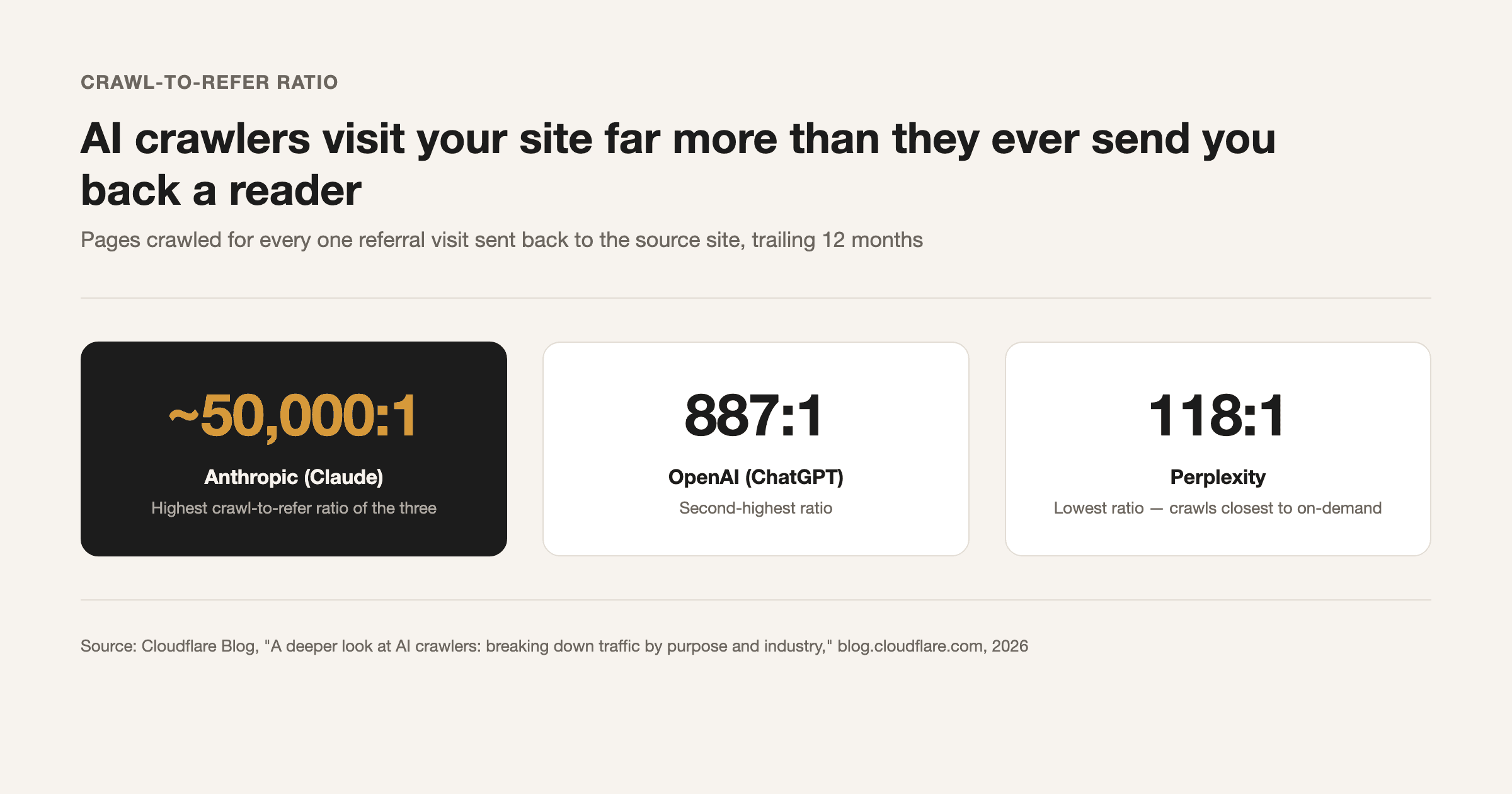
Anthropic's crawlers, per Cloudflare's own network-wide data, crawl roughly 50,000 pages for every one referral visit they send back, against 887:1 for OpenAI and 118:1 for Perplexity (Cloudflare Blog). Training crawlers in particular are built to consume, not to send readers anywhere, so don't expect crawl volume alone to show up as sessions no matter how well you configure GA4.
Reading your own logs without paying for a platform
You don't need a commercial tool to see this traffic; it's already sitting in your server or CDN logs, you just have to look. Search for user-agent strings containing `GPTBot`, `ClaudeBot`, `PerplexityBot`, `OAI-SearchBot`, or `Google-Extended`, and note the timestamp, path, and frequency. If you're behind Cloudflare, its dashboard already breaks this out by bot without extra setup. If you're running your own Nginx or Apache logs, GoAccess is a genuinely free, open-source, real-time log analyzer that can filter by user agent directly from the command line, with no SaaS subscription required.
One caution: a user-agent string alone can be faked by anyone. To be certain a request is really from the crawler it claims to be, do a reverse DNS lookup on the request's IP and confirm the hostname resolves back to the expected domain before you trust it in a report. All four major AI crawlers respect robots.txt close to 100% of the time, so a request ignoring your `Disallow` directives while claiming to be one of them is a stronger spoofing tell than the user-agent string itself.
What this adds up to
Analytics-side attribution and citation-side monitoring answer two different questions. GA4, once properly configured, tells you whether AI-referred visitors who already clicked are converting. It says nothing about whether you're being cited at all across ChatGPT, Perplexity, and Gemini for the queries that matter to you, that's a distinct, smaller category of tool; Otterly.ai is one built specifically to sample prompts across those engines and report back where you show up. Neither replaces the underlying work of earning citations in the first place, which is a content and structure problem, not an analytics one; we cover that separately in brand mentions vs. backlinks for AI citations.
This compounds slowly, not overnight. "We came for a website and left with an entire AI growth system. Within 90 days we were getting cited by ChatGPT for our category and our inbound doubled," is feedback from Rahul Mehta, founder of a B2B SaaS client AIBOOTSTRAPPER has worked with on exactly this kind of AI visibility and growth work. Ninety days is a realistic measurement window, not a week.
Where to go deeper
Getting your analytics to actually see AI-referred traffic solves the measurement half of this problem. It says nothing about how to earn the citations in the first place, or how to structure content so ChatGPT and Perplexity actually pull from it when answering a relevant query. The AI Marketing Engine covers that other half directly: the GEO and AEO tactics for getting cited, how to read AI referral data once you can see it, and how to build a measurement stack that doesn't quietly lie to you about whether the work is paying off.
Go deeper
The AI Marketing Engine
Want the full The AI Marketing Engine course, not just this post?
Join the waitlist and get a 20% launch discount the moment we open checkout. No payment now.
Taught by Aditya Jha · 40+ AI products shipped for real clients. No spam, unsubscribe any time.
Or join our free community for AI tips while you wait
One email a week: the AI tools, tactics, and course drops actually worth your time. No spam, unsubscribe anytime.
Questions about this or which course fits? Email academy@aibootstrapper.com and we'll answer it directly, not with a support ticket.