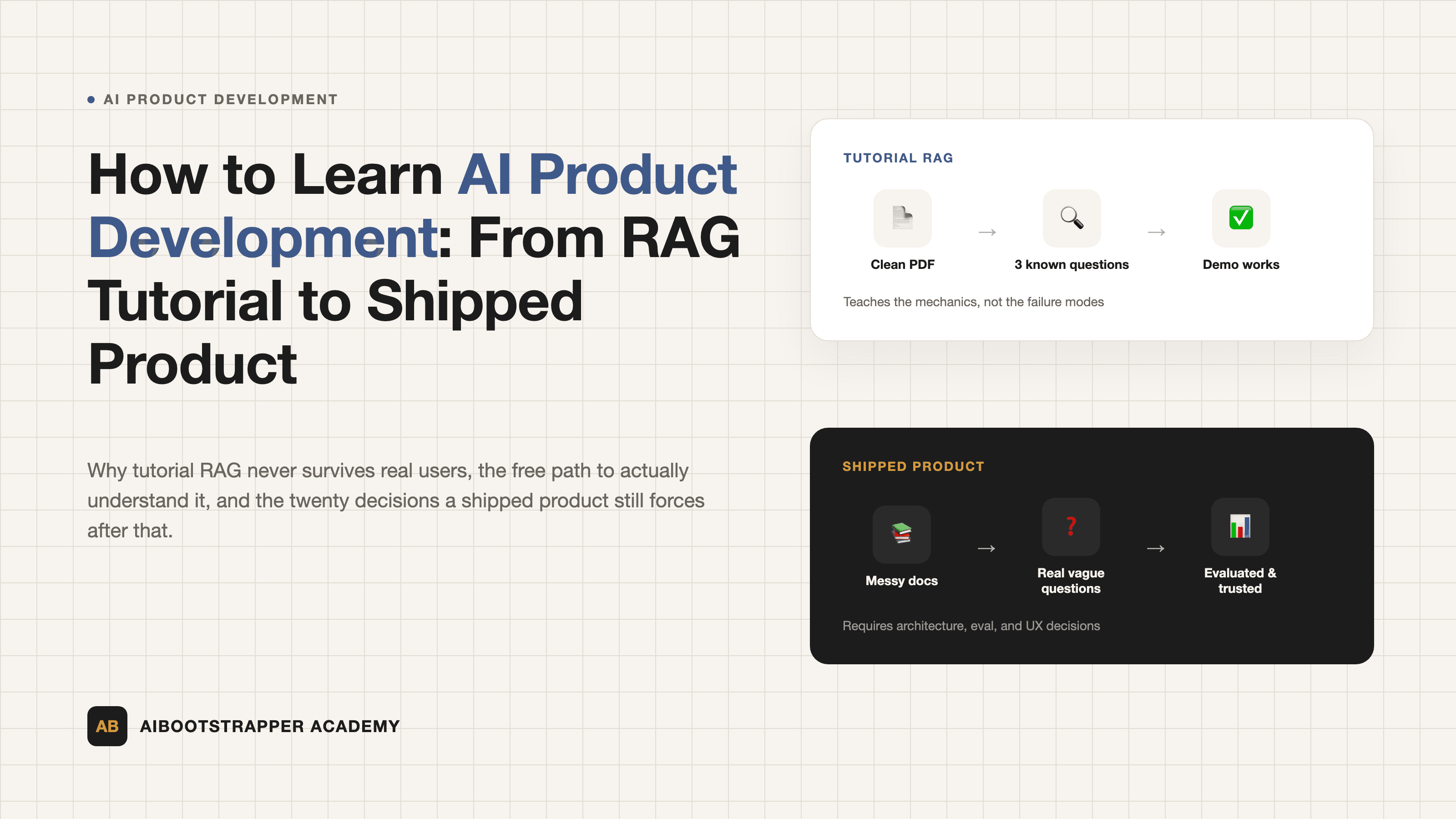
How to Learn AI Product Development: From RAG Tutorial to Shipped Product
Most "learn RAG" tutorials teach you to recite chunking, embeddings, and retrieval without ever seeing the pipeline break. Here is the free path to actually understand it, and where tutorials stop being enough.
Search "learn RAG" and you'll land on a tutorial that has you `pip install`-ing a vector database, embedding a PDF, and asking it three questions in under twenty minutes. It works. That's the problem. A RAG demo that answers three cherry-picked questions correctly teaches you almost nothing about why RAG systems fail in front of real users, and most people who go through five or six of these tutorials come out able to recite "chunking, embeddings, retrieval, generation" without having ever seen the thing break. If you're trying to actually learn AI product development, the tutorials are a fine on-ramp, but knowing where they stop mattering is the more useful skill.
Why Tutorial RAG Never Survives Contact With Real Users
A tutorial hands you a clean PDF, a fixed chunk size the author already tuned, and a handful of questions the author already knows the answer to. Real users ask questions the way people actually talk: vague, multi-part, referencing something three messages back. Your documents are messier than a tutorial's sample PDF, full of tables, headers, and boilerplate that a naive chunker slices in the worst possible place. None of that shows up until you're past the demo, which is exactly why DeepLearning.AI's free RAG course spends real time on chunking strategy and query parsing rather than just wiring up an API call, and why the honest answer to "is my RAG system good?" requires an actual evaluation loop, not five questions you already know the answer to.
What You Actually Need to Understand, Not Just Wire Up
You don't need a machine learning degree to build a working RAG product, but you do need to understand what's happening at each step well enough to debug it. An embedding model turns a chunk of text into a vector, a list of numbers positioned so that semantically similar text ends up near each other in that vector space. Retrieval means taking the user's question, embedding it the same way, and pulling back the chunks whose vectors sit closest to it, usually via cosine similarity. Generation means handing those chunks to an LLM as context and asking it to answer using only what's there. Each of those three steps has its own failure mode: a bad chunking strategy puts the right sentence in the wrong chunk, a mismatched embedding model puts similar-sounding but wrong chunks at the top of your results, and a model that ignores its context entirely writes a fluent, wrong answer anyway. If you can only debug one layer, you're guessing at fixes for a problem you haven't located. The official LangChain RAG documentation walks through the pipeline in code, but you get more out of it once you already know which of the three steps you're staring at when something breaks.
The Free Path: Real Courses and Open-Source Tools
You can learn the fundamentals for free, and you should before spending money on anything. DeepLearning.AI's RAG course and its follow-up Advanced Retrieval for AI with Chroma are both short, hands-on, and free. For the actual build, Chroma is a fully open-source, MIT-licensed embedding database you can run locally with `pip install chromadb`, no account or API key required just to store and query vectors. Pair it with Ollama, which lets you pull down and run open models like Llama or Qwen locally, and you can prototype an entire RAG pipeline, embeddings, retrieval, and generation, without a paid API key at all. This is genuinely how you should start: build something small end-to-end for free before you decide the topic is worth paying to go deeper on. If you want the fuller landscape of vector store options once you outgrow a local prototype, how pgvector, Pinecone, Weaviate, and Qdrant actually differ is worth reading before you commit to one in production.
Where Free Tutorials Stop and Production Engineering Starts
The free path gets you a working demo. It doesn't get you through the list of decisions a shipped product actually forces: whether the problem even needs RAG or a well-written prompt is enough, what happens the first time your model hallucinates in front of a paying user, whether to build your own retrieval stack or buy a managed one, and how you design a UI that makes people actually trust an answer instead of double-checking it in Google anyway. None of that is covered in a two-hour course, because none of it is really about RAG mechanics, it's product and engineering judgment that only shows up once real users and real edge cases are involved. It's also, not coincidentally, where demand for AI engineering skills has been growing fastest: LinkedIn's 2026 Skills on the Rise report put AI engineering at the top of its fastest-growing skills list, and job postings requiring AI literacy grew more than 70% year over year, because the market has plenty of people who can follow a tutorial and far fewer who can ship past one.
A Realistic Self-Teaching Roadmap
If you're doing this on your own, give yourself a real structure instead of hopping between tutorials. Week one: build the DeepLearning.AI RAG course project end-to-end with Chroma and a local Ollama model, so you understand the full loop without spending anything. Week two: break it on purpose, feed it a messy document, ask it an ambiguous question, and figure out whether the failure is retrieval or generation before you touch a single line of code. Week three: build a small labeled evaluation set, even 20 questions, and measure recall instead of eyeballing answers. Week four: pick one production concern, hallucination handling, cost, or UI trust, and go deep on just that one. This gets you real hands-on understanding. What it doesn't give you is the build-vs-buy calls, the architecture decisions, or a second set of eyes on your first real ship, and that's genuinely where a lot of self-taught builders stall out with a working demo and no clear next step.
Going From Demo to Shipped Product
If you've done the free path and have an actual product idea you want to ship, not just another local demo, that's the exact gap the AI Product Development Bootcamp is built to close. It's not an intro to what an embedding is, it assumes you can read code or work closely with someone who can, and instead spends its four weeks on the calls a tutorial never makes you make: choosing your model and architecture for a real product bet, building a production-grade RAG system with an actual eval loop, designing UX that makes an AI feature feel trustworthy instead of gimmicky, and launching with a site built to get found. If tutorial RAG got you to "I understand how this works," this is the part where you make the twenty decisions a working product actually requires.
Go deeper
AI Product Development Bootcamp
Want the full AI Product Development Bootcamp course, not just this post?
Join the waitlist and get a 20% launch discount the moment we open checkout. No payment now.
Taught by Aditya Jha · 40+ AI products shipped for real clients. No spam, unsubscribe any time.
Or join our free community for AI tips while you wait
One email a week: the AI tools, tactics, and course drops actually worth your time. No spam, unsubscribe anytime.
Questions about this or which course fits? Email academy@aibootstrapper.com and we'll answer it directly, not with a support ticket.