Best GEO Courses in 2026: What They Actually Teach (and What They Don't)
Maven, CXL, Coursera, and The GEO Community all teach GEO vocabulary and positioning. Here's the retrieval mechanism none of them fully cover, and why it's what actually determines whether AI engines cite your content.
Indeed alone carries 883 open Generative Engine Optimization postings right now, and the names hiring for them aren't growth-hack agencies. Citizens Bank, AWS, Home Depot, JPMorgan Chase, Capital One, and Palo Alto Networks are all running live GEO or AEO job listings, with manager-level roles paying $100,000 to $171,000 base plus bonus and director-level roles clearing $200,000, according to a 2026 roundup of Fortune 500 GEO and AEO postings. Naturally, a wave of "GEO courses" showed up to meet that demand. Some of them are genuinely good. Almost none of them teach the one thing that actually decides whether your content gets cited: how a model's retrieval pipeline works under the hood.
The courses that actually exist right now
If you search "best GEO course," here's what you'll actually find, and what each one is honestly good for:
- Maven's AEO Masterclass, taught live by Mostafa ElBermawy (founder of growth agency NoGood), runs two 1.5-hour cohort sessions for $499. It's strong on framework and positioning, how to think about brand visibility across ChatGPT, Perplexity, and Google's AI Overviews, but three hours of live class time isn't enough to also teach you to implement anything.
- CXL's "Optimize Pages for AI Search with GEO" is the most hands-on of the paid options, taught by Steve Toth, and focuses on building comparison content specifically structured for AI-assisted research. It's a real workflow, not just vocabulary.
- Coursera's "AI SEO: Mastering Generative Engine Optimization" is the most academically structured option, walking through FAQ formatting, schema-supported data, and AI-friendly content structures with graded exercises.
- The GEO Community is free, no paywall, no signup wall, and publishes genuinely original experiment write-ups and measurement guides. It's the best zero-cost starting point, but it's a blog you browse, not a curriculum with accountability for finishing it.
All four are worth something. None of them spend real time on the mechanism that actually gates citation: what happens between a user's question and a model deciding your paragraph is the one worth quoting.
What none of them fully teach: how a model decides what to cite
Here's the part that gets skipped in almost every GEO course, framework, and LinkedIn post: an AI answer engine doesn't read your page and judge it holistically. It breaks a query into sub-questions, retrieves candidate passages from an index built out of your content, and ranks those passages by how well they match, before a model ever writes a word of the answer. That retrieval step is where most content quietly loses, long before "quality" or "authority" get a vote.
Anthropic's own engineering research on Contextual Retrieval is the clearest public explanation of why this fails so often. Standard RAG systems split documents into chunks of a few hundred tokens for embedding and retrieval, and Anthropic found that splitting strips away exactly the context a chunk needs to be found: a sentence like "the company's revenue grew 3% last quarter" is useless in isolation if the chunk doesn't say which company or which quarter. Anthropic's fix, prepending chunk-specific context before embedding, cut failed retrievals by 49%, and by 67% when combined with reranking. That's not a marginal optimization. It's the difference between your page existing in a model's index and actually surfacing.
Lumar's analysis of AI extractability backs the same finding from the content side: retrieval systems typically operate at the passage level, pulling 100-to-300-word sections that match a query semantically, not whole pages. And they call out the same failure Anthropic's research does from the writer's side, the "pronoun penalty": a paragraph that says "it grew 3%" instead of naming the company loses entity clarity the moment it's lifted out of its original page and evaluated on its own.
Why the mechanism matters more than the vocabulary
This is the actual skills gap. A 2026 survey of 150 B2B marketers found most teams can define GEO but few can execute it, and the reason tracks directly with what's above: knowing the term "answer engine optimization" doesn't tell you that your product comparison page needs each section to stand alone as a self-contained, entity-named chunk, because that's the actual unit a retrieval system scores. A course that teaches you the vocabulary and the positioning without ever touching how chunking, embeddings, and reranking work leaves you able to talk about GEO in a meeting but not able to diagnose why a specific page isn't getting cited.
We've covered the adjacent structural pieces separately, why schema markup alone doesn't move citations and how often content actually needs updating to stay cited, and the retrieval mechanism above is the piece that ties both together: schema and freshness are signals a retrieval system uses to trust a chunk once it's already a candidate, but the chunk has to be structurally retrievable in the first place.
What GEO roles are actually paying, by level
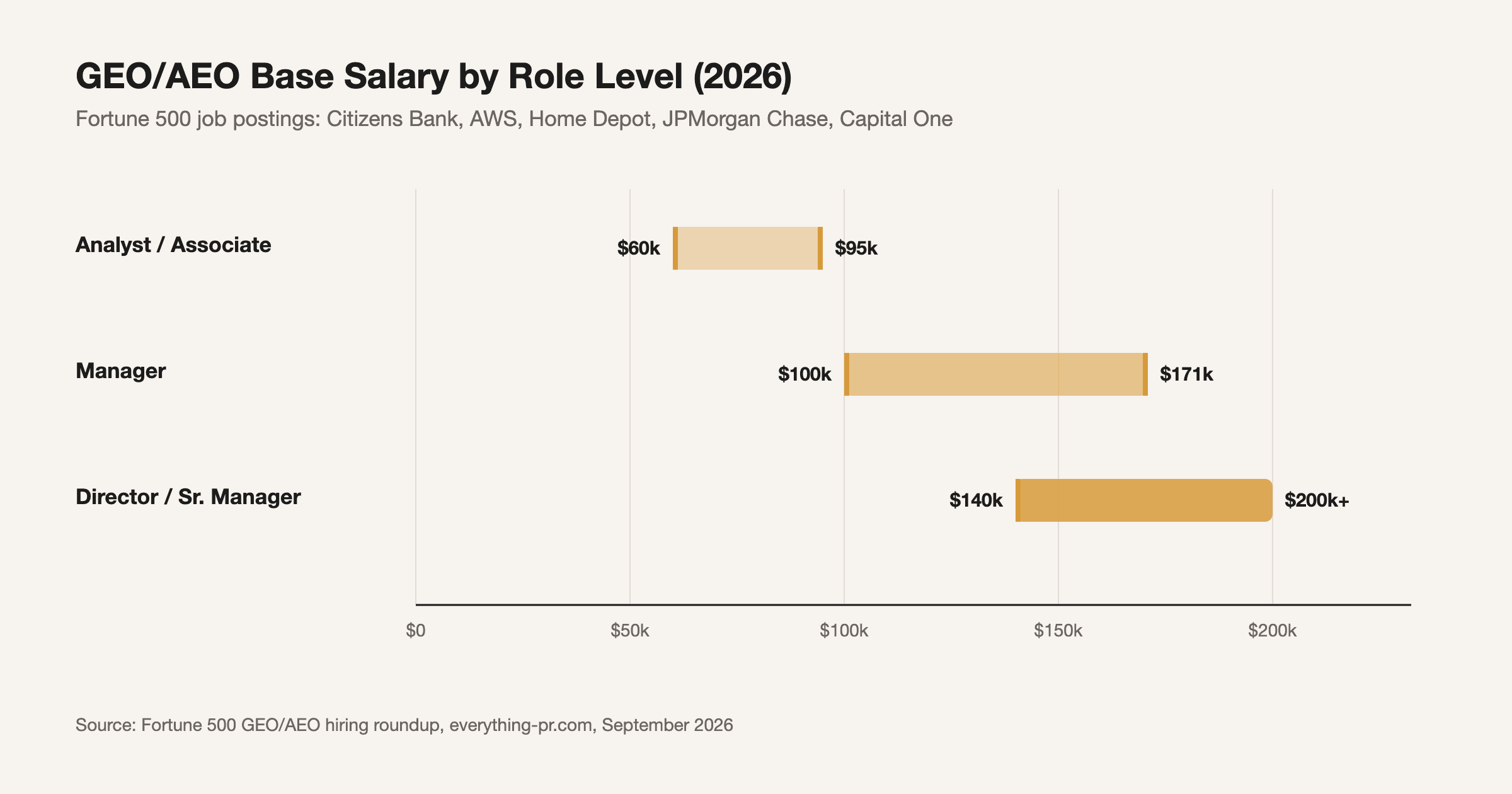
That pay curve is worth sitting with. The jump from analyst to manager isn't about knowing more GEO terminology, it's the difference between someone who can write an AI-friendly paragraph and someone who can audit why an entire site's comparison pages aren't retrievable and fix the pipeline, not just one page.
A checklist, regardless of which course you pick
Whichever course or free path you go with, make sure it actually gets you to these, since this is what the mechanism above translates to in practice:
- Every section of a page reads as a self-contained, entity-named chunk, no pronoun standing in for the company, product, or study name three sentences later.
- Schema markup (`Article`, `FAQPage`, `Product`) is in place so structured signals back up what the prose already says plainly.
- You have a real update cadence for your highest-value pages, not a one-time publish, since freshness is a machine-checkable signal, not a vibe.
- You can actually see whether any of it is working, via GA4's AI referral tracking or server-log analysis, not just guessing from ChatGPT screenshots.
Where a structured course still earns its cost
None of the four options above are wrong to take. But if you want the mechanism above taught as a buildable skill, not a framework you nod along to, that's specifically what The AI Marketing Engine's "GEO content that gets cited by AI" module is built around: entity and schema structuring for AI answers, writing content ChatGPT and Perplexity will actually cite, and measuring AI citations directly instead of proxy metrics. It's the same retrieval mechanism covered above, taught as a repeatable process against a real client-style project, not a weekend framework.
That's the outcome one AIBOOTSTRAPPER client described directly: "We came for a website and left with an entire AI growth system. Within 90 days we were getting cited by ChatGPT for our category and our inbound doubled," said Rahul Mehta, founder of a Bengaluru-based B2B SaaS company, describing the same citation mechanism this post just walked through, applied to his own site. The vocabulary got him in the door. The mechanism is what actually got him cited.
Go deeper
The AI Marketing Engine
Want the full The AI Marketing Engine course, not just this post?
Join the waitlist and get a 20% launch discount the moment we open checkout. No payment now.
Taught by Aditya Jha · 40+ AI products shipped for real clients. No spam, unsubscribe any time.
Or join our free community for AI tips while you wait
One email a week: the AI tools, tactics, and course drops actually worth your time. No spam, unsubscribe anytime.
Questions about this or which course fits? Email academy@aibootstrapper.com and we'll answer it directly, not with a support ticket.