Vapi vs Retell vs Bland AI: How to Actually Build a Voice AI Agent
Every voice AI platform demo sounds great until the first real call has a dead-air gap. The real decision isn't features, it's latency, and open-source Pipecat or LiveKit Agents can beat Vapi, Retell, and Bland AI if you're willing to self-host.
A voice AI agent sounds like a solved problem until you actually try to ship one: the demo on every platform's homepage sounds great, and then your first real test call has a half-second dead-air gap after you finish a sentence, or the agent barges in while you're still thinking out loud. That gap is not a bug you can fix with a better prompt. It's latency, and it's the actual design constraint every voice agent platform is built around, whether or not their marketing page says so.
The pipeline: how a voice agent actually hears, thinks, and talks
Underneath the chat bubble, a voice agent is three models stitched into one pipeline. Speech-to-text (STT) turns the caller's audio into text. A large language model reasons over that text and the conversation so far, then produces a reply. Text-to-speech (TTS) turns that reply back into audio the caller hears. Run those three steps one after another, each waiting for the last to finish, and you get the dead-air problem: a caller who finishes a sentence, then sits through transcription time, plus model inference time, plus speech synthesis time, stacked in series.
Every production voice stack exists to collapse that series into something closer to parallel. STT streams partial transcripts to the LLM before the caller has even finished the sentence. The LLM streams tokens to the TTS engine as they're generated instead of waiting for a complete response. And the hardest part, deciding when the caller is actually done talking rather than just pausing to think, runs as its own detection problem, because guessing wrong in either direction breaks the conversation.
Why the real metric is latency, not accuracy
Natural human conversation has almost no gap in it. Research cited in Parloa's analysis of voice AI latency puts the average response offset between human speakers at 0 to 200 milliseconds; wait much past 300ms and it starts reading as hesitation. Practitioner benchmarks for voice agents converge on a looser but still tight target: a roughly 800ms budget from the caller's last word to the agent's first audible sound, with teams chasing sub-500ms as a stretch goal.
The single biggest line item in that budget is usually not the LLM. It's endpointing — deciding the caller has actually stopped talking. One breakdown of the problem puts a naive fixed-silence timer at 200 to 600ms: set it too short and the agent interrupts callers who paused mid-thought, set it safe and you waste 400ms doing nothing on every single turn. This is exactly why LiveKit's Agents framework ships a dedicated semantic turn-detection model rather than a silence timer — it's reading the actual words for completion cues ("...and that's everything" versus a trailing "and, umm") to decide whether to respond now or keep listening, which is a real modeling problem, not a timeout you tune once and forget.
Three managed platforms, three different bets
If you don't want to own this pipeline yourself, three platforms dominate the current comparisons: Vapi, Retell AI, and Bland AI. Each one is making a different bet about where you want control versus speed.
| Platform | Best for | The trade-off |
|---|---|---|
| Vapi | Teams who want to pick their own STT, LLM, and TTS vendors | You own and pay each vendor separately; more flexibility, more integration work |
| Retell AI | Shipping a managed inbound phone agent fast | Less control over the underlying stack, but live in days not weeks |
| Bland AI | High-volume outbound campaigns | Deterministic "Pathways" flows trade some conversational flexibility for predictability at scale |
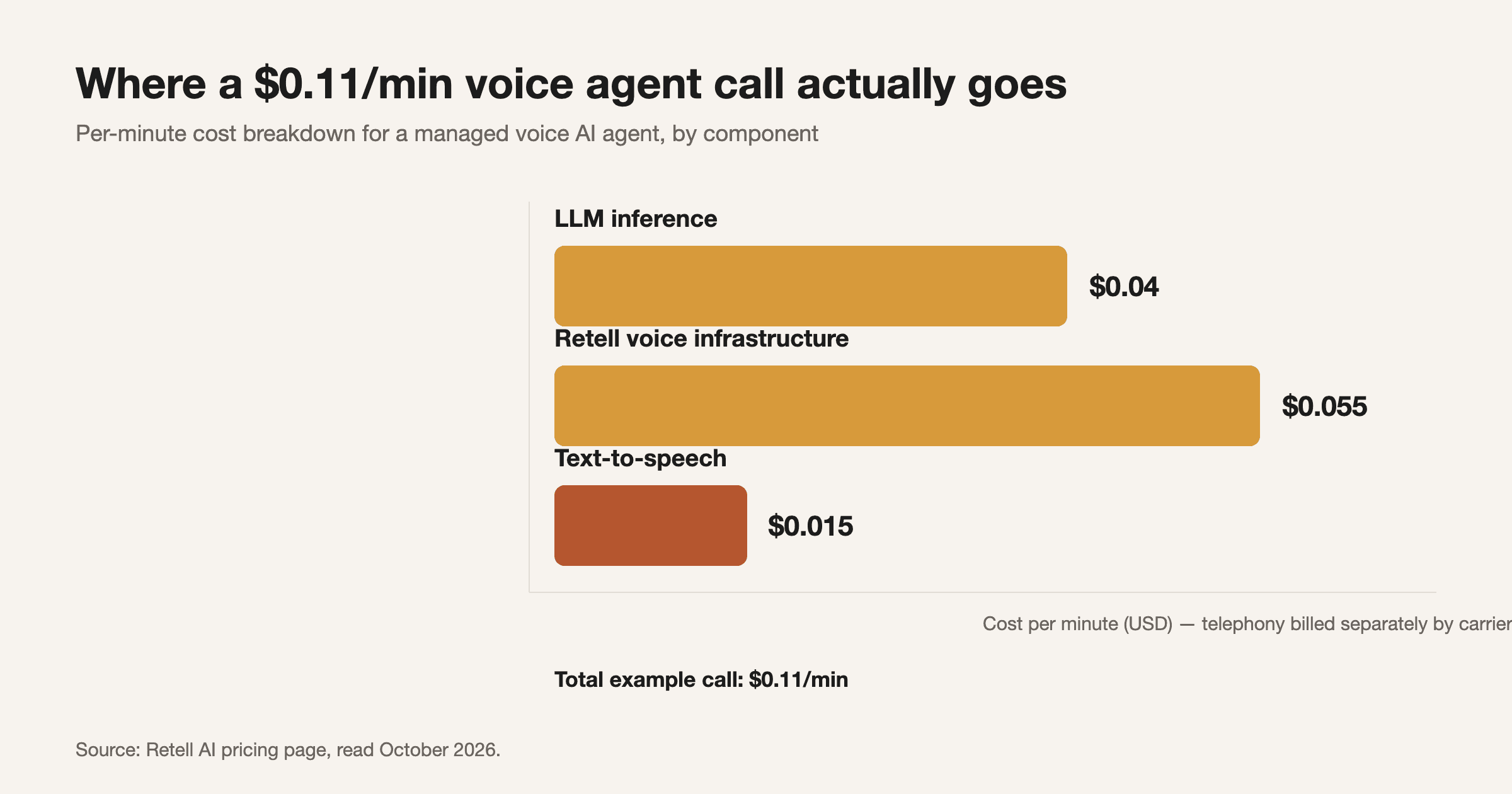
Retell publishes real per-minute math on its own pricing page that's worth looking at even if you end up elsewhere, because it's the clearest public breakdown of where a voice-agent minute actually goes: its example call comes to $0.11/min, split across a $0.04 LLM cost, $0.055 for Retell's own voice infrastructure, and $0.015 for text-to-speech, with telephony billed separately per carrier (commonly another $0.015/min on top). Add-ons like PII removal or advanced denoising stack on from there, and the full range across providers and models runs $0.07 to $0.31/min depending on what you choose. Vapi's own docs describe the same three-part architecture, just with you choosing and billing each vendor (OpenAI, Anthropic, Deepgram, ElevenLabs, and others) directly instead of paying one bundled rate.
The free, open-source route: you can self-host the whole stack
If per-minute vendor margin bothers you, or you need to keep calls on infrastructure you control, two open-source frameworks now cover most of what the paid platforms do. Pipecat, a BSD-2-licensed Python framework with over 16,000 GitHub stars, is built around composable pipelines: you plug in whichever STT, LLM, and TTS providers you want (it already supports 20+ of each) and it handles the streaming and orchestration between them. Its official docs are a reasonable starting point even if you end up building on something else, since the core pipeline concepts translate across the ecosystem.
LiveKit Agents, Apache-2.0 licensed, takes a different angle: it's built on top of LiveKit's own open-source WebRTC media server, so a fully self-hosted deployment means running that server too, not just the agent code. What you get for that extra piece is native SIP telephony (inbound and outbound calls without bridging through Twilio separately), the semantic turn-detection model mentioned above, and built-in MCP support so an agent can call the same tools you'd expose to Claude. LiveKit's own docs cover the voice quickstart in detail. The honest trade-off most comparisons land on: Pipecat is the faster path if you want a flexible pipeline for a single-caller use case, LiveKit Agents is the better fit once you need real multi-participant rooms or native telephony at the infrastructure level.
How to actually decide
Start from what you're optimizing for, not from which platform has the best demo. Need an inbound agent live this month and don't have spare engineering time to babysit a self-hosted stack? Retell's managed path is built for exactly that. Have engineers who want to swap models freely and are comfortable owning a few vendor relationships? Vapi's bring-your-own-stack model fits. Running outbound campaigns at real volume where predictable call flows matter more than open-ended conversation? Bland's Pathways are built for that specific job. And if the per-minute margin on a managed platform doesn't pencil out at your call volume, or you need the agent to run entirely inside your own infrastructure for compliance reasons, Pipecat or LiveKit Agents get you the same pipeline without the vendor markup, at the cost of owning the ops yourself.
None of this is a toy-demo decision. A voice agent that mishandles the 800ms window, mis-detects a turn, or picks the wrong provider for your call volume is a broken customer experience with a dial tone, not a buggy UI you can patch quietly. That's the same category of production decision — pick the right tool, wire it into your real CRM and lead pipeline, monitor it so it doesn't fail silently — that AI Automation Mastery is built around, just applied to phone calls instead of WhatsApp or Slack. If you've already built agent workflows with n8n, the mental model carries straight over: a voice platform is another channel your agent answers on, with its own latency budget instead of its own API quirks.
Go deeper
AI Automation Mastery
Want the full AI Automation Mastery course, not just this post?
Join the waitlist and get a 20% launch discount the moment we open checkout. No payment now.
Taught by Aditya Jha · 40+ AI products shipped for real clients. No spam, unsubscribe any time.
Or join our free community for AI tips while you wait
One email a week: the AI tools, tactics, and course drops actually worth your time. No spam, unsubscribe anytime.
Questions about this or which course fits? Email academy@aibootstrapper.com and we'll answer it directly, not with a support ticket.