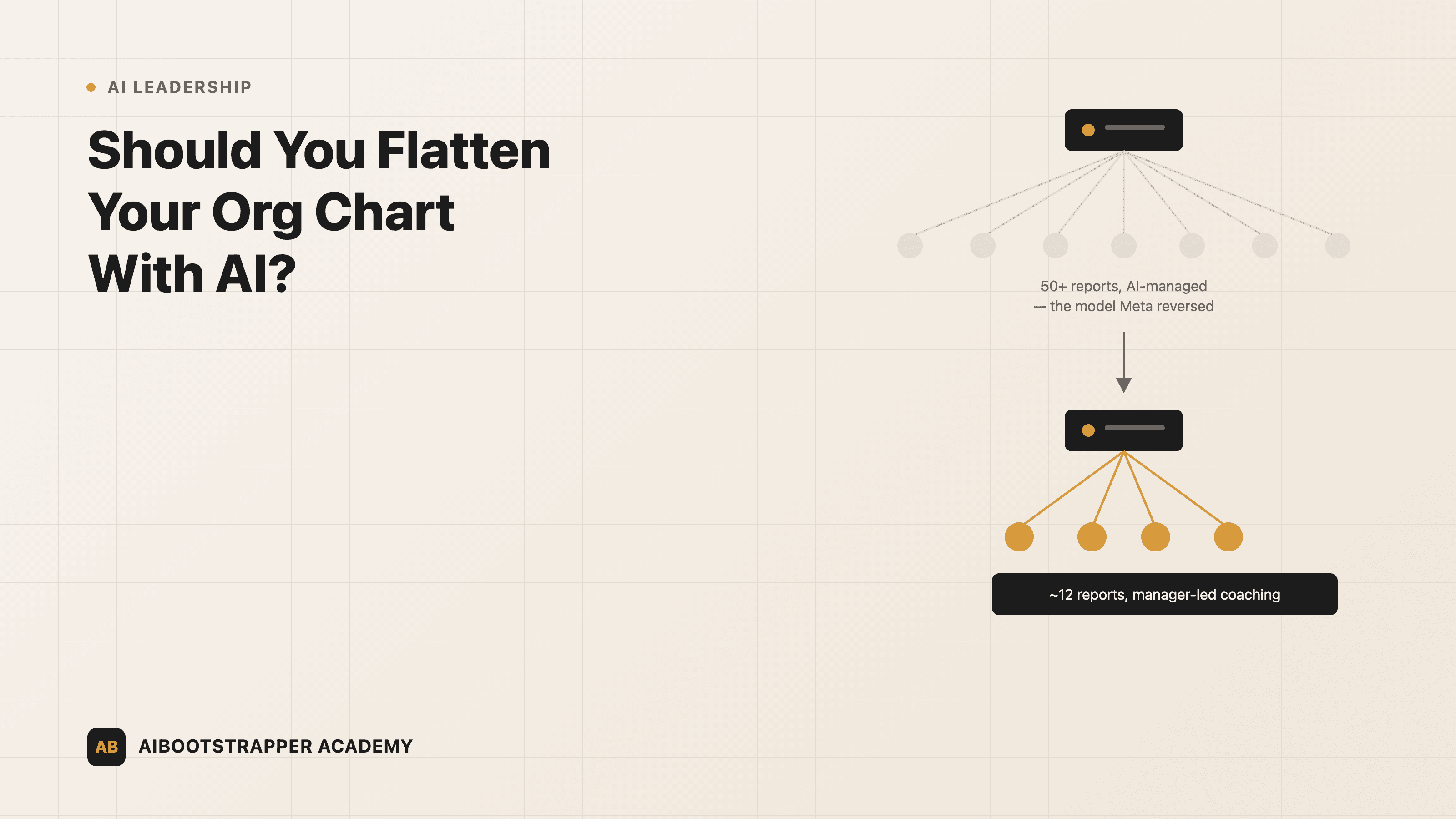
Should You Flatten Your Org Chart With AI? What Meta's Reversal and the Real Span-of-Control Data Show
Gartner predicts 20% of companies will use AI to eliminate half their middle-management roles by 2026. Meta tried spans of 50+ direct reports per AI-assisted manager, then reversed course. Here's what the data actually says about how wide a manager's span of control can go.
Gartner predicts that through 2026, one in five organizations will use AI to flatten their structure by eliminating more than half of their current middle-management positions. That prediction stopped being theoretical months ago. When Cloudflare cut roughly a fifth of its workforce in the middle of a record revenue quarter, CEO Matthew Prince told staff that most of the people let go were what he called "measurers", middle managers, finance, legal, and internal audit roles built to report on other people's work rather than do it, according to Fortune's reporting on the shift. Cloudflare isn't an outlier. The same reporting cites a Korn Ferry survey of 15,000 professionals worldwide in which 41% said their company trimmed a management layer in the past year.
If you're a founder watching this from the outside, the pitch sounds clean: AI absorbs the coordination overhead, one manager can oversee more people, headcount costs drop, and the org chart gets flatter and faster. The actual data on how wide that span can get, and where it snaps, is a lot more specific than the pitch.
Why AI Makes Wider Spans Possible, Mechanically
A manager's job splits into two very different kinds of work: administrative coordination (scheduling, status rollups, tracking who's blocked on what, drafting performance summaries) and relational work (coaching a struggling report, resolving a conflict between two teammates, making a judgment call about who's ready for more responsibility). Gartner's own reasoning for its prediction is that AI can absorb the first category almost entirely, automating scheduling, reporting, and performance monitoring, which is exactly the busywork that currently caps how many people one person can reasonably track. Cut that overhead and, in theory, a manager can hold a much bigger span without dropping anything.
That logic isn't wrong. It's just incomplete, because it treats management as if it were only the first category.
How Wide Spans Have Actually Gotten
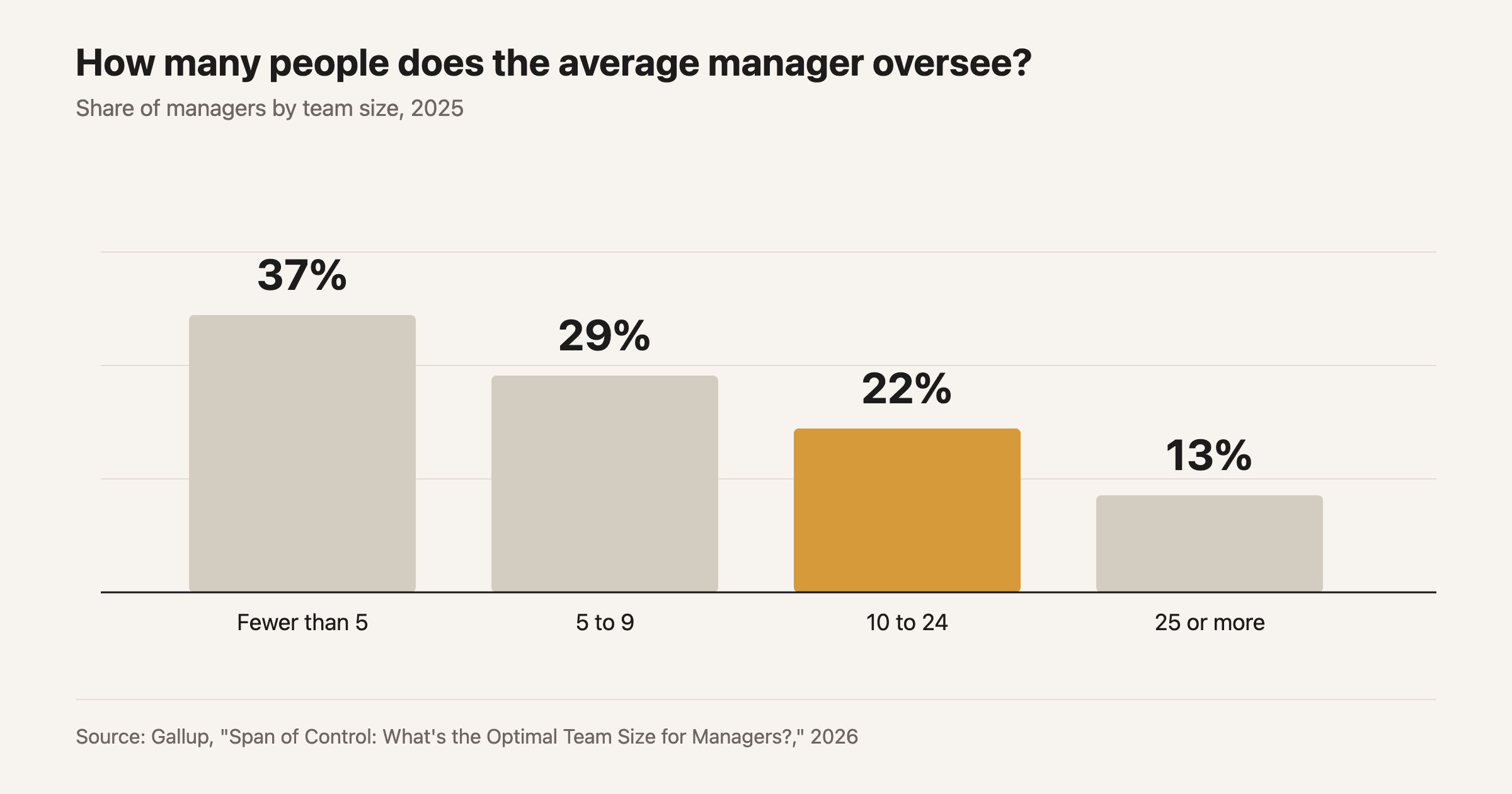
The trend is real and it's already showing up in the numbers. Gallup's ongoing span-of-control research puts the average manager's direct-report count at 10.9 in 2024 and 12.1 in 2025, a jump the firm describes as nearly a 50% increase since it first started measuring in 2013. But the average hides the spread: 37% of managers still oversee fewer than five people, another 29% manage five to nine, 22% run teams of 10 to 24, and 13% now carry 25 or more direct reports, the group most likely to be working the AI-assisted model Gartner is describing.
That top group is also where the visible strain shows up first, which is exactly what one very public case study demonstrated.
Where It Breaks: Meta's Retreat From 50-Person, AI-Managed Teams
In 2025, part of Meta's Reality Labs organization ran the experiment at the far end of the curve: managers supervising more than 50 direct reports, with AI coaching and decision-support tools meant to offload the developmental conversations a manager normally has one-on-one. It didn't hold. Reality Labs VP Andrew Bosworth issued an internal memo reversing course, capping manager spans at roughly 20 direct reports and explicitly prioritizing personalized managerial attention again, as detailed in this breakdown of the reversal. The underlying admission was simple: AI can summarize a report's output and flag a missed deadline, but it can't read the room in a hard conversation, can't build the trust that makes someone admit they're struggling before it becomes a resignation letter, and can't make the judgment call about who's ready for a promotion. That's exactly the failure mode we walk through from the rollout side, not the org-design side, in why AI rollouts fail at the middle-manager layer: the work doesn't disappear when you remove the layer, it either gets absorbed badly or it stops happening at all.
What Actually Determines Whether Flattening Works
The more useful finding buried in Gallup's research isn't the average span, it's what predicts whether a wide span succeeds or backfires. Gallup's meta-analysis of over 92,000 teams found that manager talent matters more than headcount: highly engaged teams of 12 or more can and do thrive under one manager, but only when that manager spends less than 40% of their own time on individual-contributor work, and when the team gets meaningful, weekly feedback, a rhythm Gallup ties to nearly tripling the share of engaged employees. A wide span staffed by a strong manager who's been freed from admin work is a different bet than a wide span used to justify cutting a manager entirely and leaving the team to a dashboard.
A Founder's Framework: When to Flatten, When Not To
- **Audit what the role actually does before removing it.** If a manager's week is mostly status aggregation and calendar tetris, AI absorbs that cleanly. If it's coaching, conflict resolution, or judgment calls about people, it doesn't, no matter how good the AI coaching tool's marketing page looks.
- **Treat 40% as the real ceiling, not a nice-to-have.** Gallup's own data ties manager time spent on individual-contributor work above that threshold to falling engagement. If flattening pushes a manager past it, you've made the span wider than the manager, not just the org chart.
- **Watch voluntary turnover among your best people first.** It's the leading indicator that shows up before output numbers move, and it's the exact signal that forced Meta's reversal.
- **Don't dismantle the pipeline you'll need in three years.** Someone on your team has to become your next VP or head of function, and that happens through real people-management reps, not a wider span with a chatbot standing in for a mentor.
- **Pilot on one team before you rewrite the whole chart.** Meta ran its 50-report experiment inside one division and reversed it there, before it spread company-wide. That containment, not the initial bet, is the part worth copying.
Flattening isn't automatically a mistake, and it isn't automatically a win either; it's a bet on exactly which parts of management are administrative overhead versus which parts are the actual job, and Gartner, Gallup, and Meta's own reversal all land on the same answer: get that split wrong and the org chart gets thinner while the actual work of managing people quietly stops happening. That's the specific judgment call, alongside deciding whether a role needs a dedicated AI owner at all, that AI Leadership for Founders is built around: not just adopting AI tools, but making the structural calls, like whether you need a fractional or founder-led AI lead in the first place, before a headcount decision made under cost pressure turns into a retention problem six months later.
Go deeper
AI Leadership for Founders
Want the full AI Leadership for Founders course, not just this post?
Join the waitlist and get a 20% launch discount the moment we open checkout. No payment now.
Taught by Aditya Jha · 40+ AI products shipped for real clients. No spam, unsubscribe any time.
Or join our free community for AI tips while you wait
One email a week: the AI tools, tactics, and course drops actually worth your time. No spam, unsubscribe anytime.
Questions about this or which course fits? Email academy@aibootstrapper.com and we'll answer it directly, not with a support ticket.