How to Learn AI From Scratch in 2026: A 5-Step Roadmap for Founders and Non-Engineers
A practical five-step path to learning AI in 2026: get literate, pick one track, build a project, learn to evaluate it, then ship. With real free resources and honest limits of self-study.
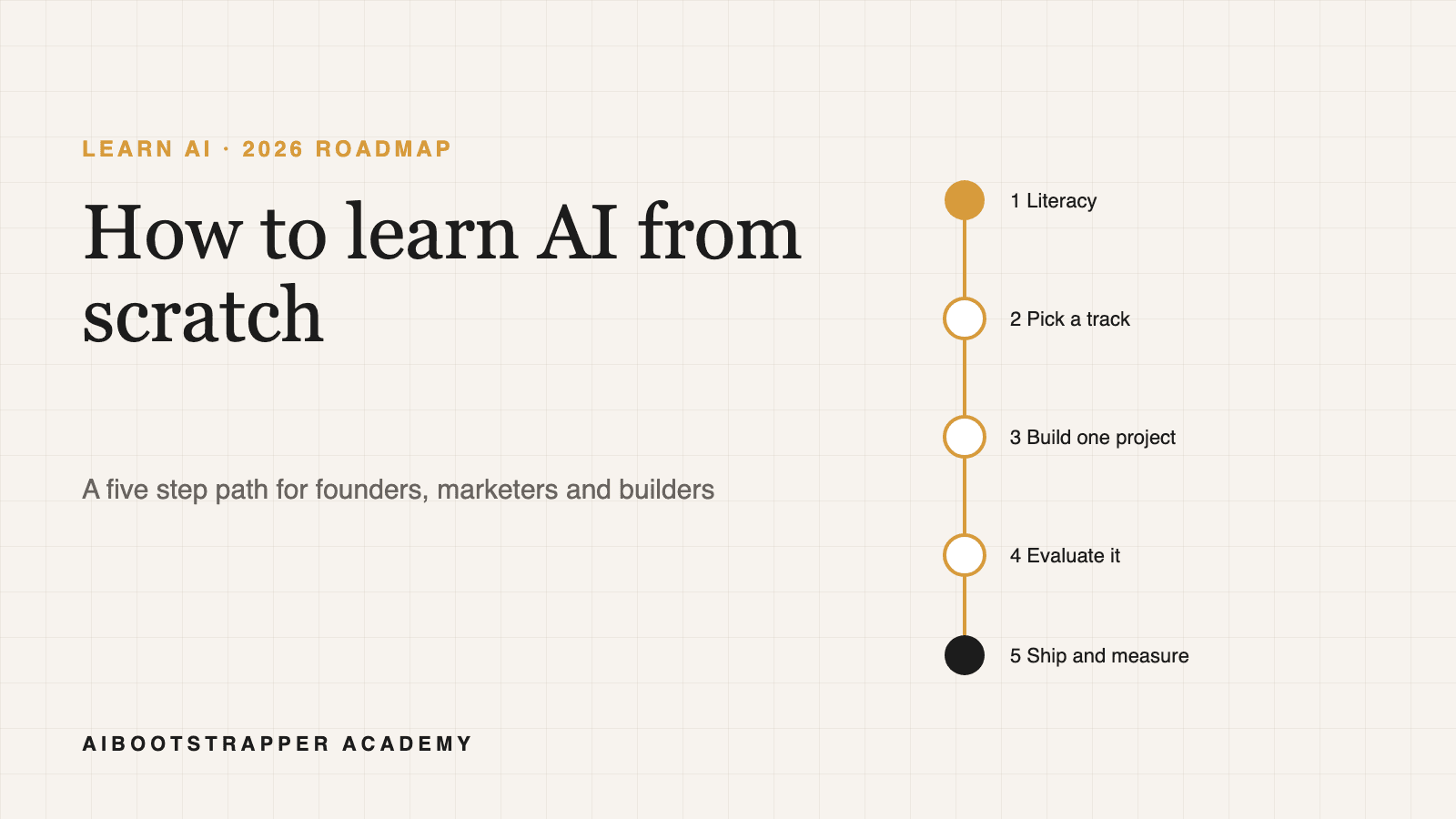
The short answer: learn AI in five steps, in this order. First, get literate in what language models can and cannot do. Second, pick one track that matches your job (automation, marketing, product, or leadership). Third, build one small real project. Fourth, learn to evaluate it. Fifth, ship it and measure the result. Most people who stall skip step three or four and stay in tutorial mode forever.
This guide is written for founders, marketers and non-engineers who keep asking "how do I actually learn AI in 2026?" It names real free resources, explains the mechanism behind each step, and is honest about where free material stops being enough.
Step 1: Get AI literate before you touch a tool
Before building anything, understand what a large language model is: a system that predicts the next token given a context window of text. That one fact explains hallucination (it predicts plausible text, not verified text), why prompts matter, and why giving a model your own documents changes its answers.
There are good free or low-cost places to start. DeepLearning.AI lists beginner courses such as Generative AI for Everyone (about 5 hours) and AI Prompting for Everyone, with the first described as covering AI's capabilities and limitations plus business and societal impact. Anthropic's learning site includes AI Fluency and AI Capabilities and Limitations courses. Check each page for current pricing, since the catalog pages do not state it.
Spend a week here, not a month. The goal is vocabulary: token, context window, prompt, tool call, embedding, RAG. If you can explain those to a colleague, move on.
Step 2: Pick one track, not all of AI
"Learn AI" is too broad to be a goal. In practice there are four job-shaped tracks:
- **Automation and agents:** connect models to tools like email, CRMs and spreadsheets so work runs without you. Start with n8n, which you can self-host free, and see our n8n vs Zapier vs Make comparison.
- **Marketing and visibility:** learn how AI search engines choose what to cite, then structure content for it. Our GEO vs SEO explainer is the place to begin.
- **Product development:** RAG, embeddings, model choice and cost control. Start with how to learn AI product development from RAG tutorial to shipped product.
- **Leadership:** deciding where AI belongs in a company, who owns the risk, and how to drive adoption. See why AI pilots fail and how to be in the 5 percent.
If you are an engineer who wants model internals, the Hugging Face Learn hub lists structured courses on LLMs, AI agents and post-training. If you are a non-engineer, you can skip most of that and still build useful systems.
Step 3: Build one small project with a real input and a real output
Tutorials teach you to follow instructions. Projects teach you what breaks. Choose something with a real input you already have and a real output someone will use: a workflow that drafts replies to inbound leads, a bot that answers questions from your own PDFs, a weekly report that summarizes a spreadsheet.
Run it on free tooling first. Ollama lets you run open models locally, and we walk through it in self-hosting a free ChatGPT alternative with Ollama and Open WebUI. Free and open source tools are genuinely enough to learn the mechanics. Their limits show up later, in reliability and scale, not in what you can understand.
One mechanism worth knowing: an agent is a loop. The model reads the task and the list of tools available, decides whether to call one, you run the tool, feed the result back into the context, and the model decides again. Every agent framework, paid or free, is a variation on that loop.
Step 4: Learn to evaluate, because this is where most courses stop
A demo that works once is not a system. Evaluation means running a fixed set of known inputs through your workflow and checking the outputs against expectations, so you can tell whether a change made things better or worse.
n8n's documentation describes two kinds. Light evaluation happens before deployment, with a small hand-made dataset where you compare outputs visually and iterate. Metric-based evaluation happens after deployment, using a larger dataset that often comes from real executions, with each output scored numerically so you can rerun it as a regression test after every fix.
You can apply the same idea in any tool. Keep 20 real examples, write down what a good answer looks like, and rerun them whenever you change a prompt or model. For the deeper version, read evaluating AI agents in production.
Step 5: Ship it, measure it, and know the limits of self-study
Put the project in front of a real user, measure time saved or revenue influenced against a baseline you recorded beforehand, and write down what failed. Our piece on how to measure AI ROI covers the baseline step.
Self-study has honest limits. Free courses are strong on concepts and weak on feedback: nobody reviews your workflow, tells you it will fail at 10,000 runs, or explains why a client's API change broke it. Our comparison of free vs paid n8n courses lays out when paying is worth it and when it is not.
Which course matches which goal
If you are still deciding, this is how we map goals to learning paths at AIBOOTSTRAPPER Academy:
- Want to automate work with agents and workflows: AI Automation Mastery.
- Want to market with AI and show up in AI search answers: The AI Marketing Engine.
- Want to build AI products: AI Product Development Bootcamp.
- Want to lead AI adoption in your company: AI Leadership for Founders.
These are built by Aditya Jha from real client work at AIBOOTSTRAPPER, so they emphasize the project and evaluation steps above, the parts free material tends to skip. Start with the free resources in step one regardless. If you reach step three and want structured feedback, that is the point where a course earns its price.
Frequently asked questions
**Can I learn AI without coding?** Yes for automation, marketing and leadership tracks, using visual tools like n8n. Product development eventually needs some code, though AI coding assistants lower that bar.
**How long does it take?** Literacy takes about a week. A first working project typically takes a few weekends. Competence comes from repeating steps three and four on progressively harder problems.
**Should I learn Python first?** Not unless you are heading into the product or engineering track. Pick a project first and learn only the code it needs.
Go deeper
AI Automation Mastery
Want the full AI Automation Mastery course, not just this post?
Join the waitlist and get a 20% launch discount the moment we open checkout. No payment now.
Taught by Aditya Jha · 40+ AI products shipped for real clients. No spam, unsubscribe any time.
Or join our free community for AI tips while you wait
One email a week: the AI tools, tactics, and course drops actually worth your time. No spam, unsubscribe anytime.
Questions about this or which course fits? Email academy@aibootstrapper.com and we'll answer it directly, not with a support ticket.