n8n vs Zapier vs Make for AI Agent Workflows: Why the Pricing Model Decides More Than the Feature List
Zapier bills per task, Make bills per operation, n8n bills per execution — and that difference barely matters until an AI agent starts looping. Here is the real cost math for agentic workflows.
Every comparison of n8n, Zapier, and Make lines up their feature grids side by side and calls it a day: app count, AI capabilities, ease of use. That comparison was fine when automations were simple triggers ("new form response, add a row"). It falls apart the moment you add an AI agent into the workflow, because an agent doesn't run a fixed number of steps. It reasons, calls a tool, checks the result, sometimes loops back and tries again. That single behavioral difference changes which platform is actually cheap and which one quietly bankrupts you, and almost none of the comparison articles do the arithmetic on it.
What a "Task," an "Operation," and an "Execution" Actually Are
The three platforms don't just price differently, they meter differently, and the unit each one counts is the whole story.
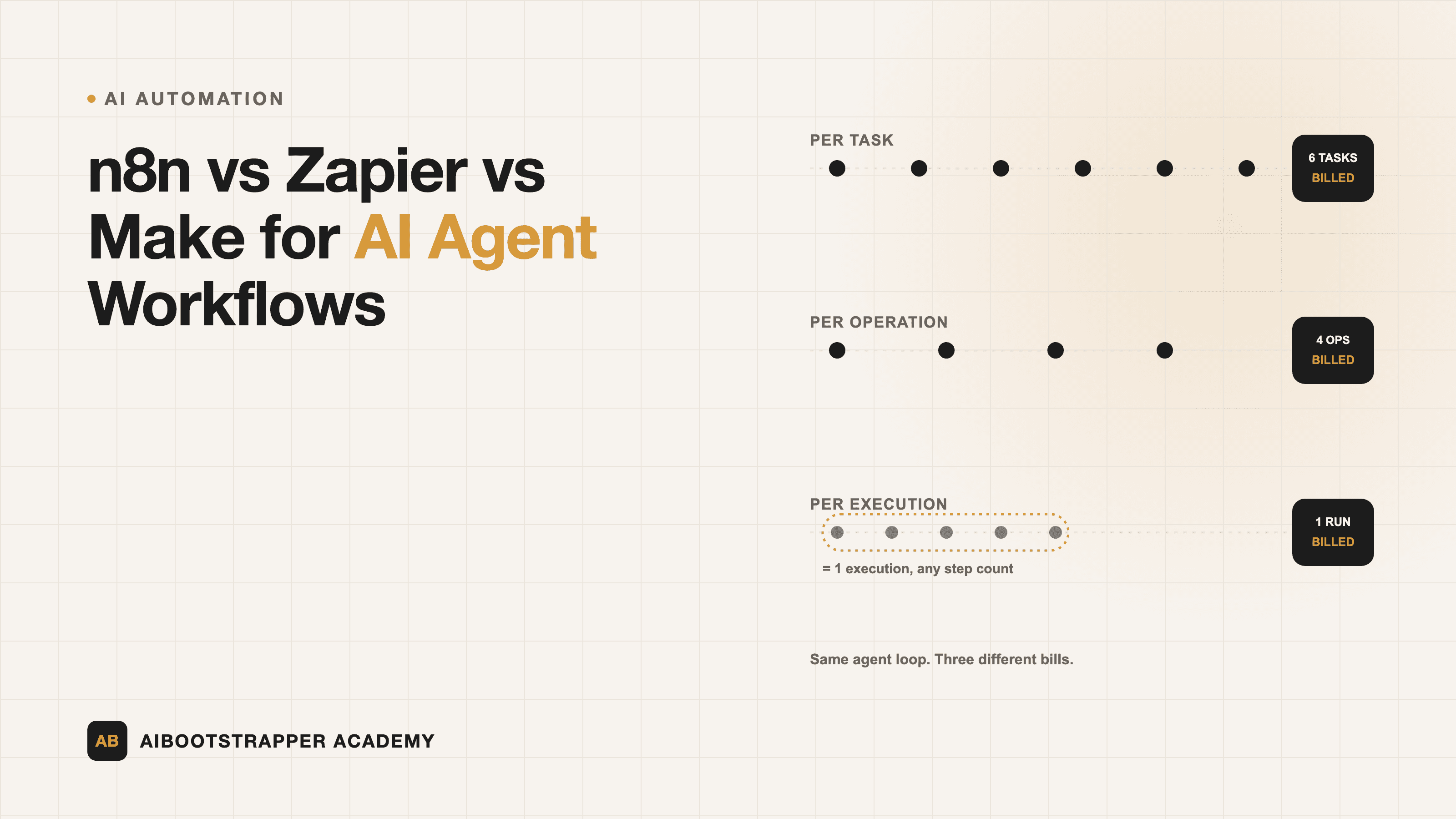
Zapier bills per task, and a task is every single action a Zap runs. A workflow that reads a new lead, enriches it, and posts to Slack burns three tasks per run, confirmed on Zapier's own pricing page where plans are sold as fixed monthly task allotments (Professional at roughly $29.99/month for 750 tasks, scaling up to Enterprise). Make counts operations the same way: Make's pricing treats each module that executes as one operation, so a five-module scenario burns five operations per run, and its Core plan sells roughly 10,000 operations for about $10.59/month.
n8n counts neither. It bills per execution, and one execution is a single run of the entire workflow regardless of how many nodes are inside it, as n8n's own pricing page states directly. A 3-step workflow and a 40-step workflow both cost exactly one execution per run. That's already a meaningfully different economic model before AI enters the picture at all.
Why an AI Agent Loop Breaks the Naive Comparison
Here's where it gets interesting. A deterministic Zap or Make scenario runs the same fixed number of steps every time, so you can predict your task or operation count in advance. An AI agent can't make that promise. Look at how n8n's AI Agent node actually works: it's built on LangChain's agent architecture, meaning the model receives a goal, decides which tool to call, evaluates the tool's output, and decides whether it needs another tool call or is done. A question that resolves in one tool call on a good day might take four tool calls, a retry, and a fallback on a bad day, because the model's own reasoning path isn't fixed at design time.
On Zapier or Make, every one of those tool calls is a separate action, which means a separate task or operation. A workflow that looked like it cost 3 tasks per run in testing can cost 8 or 12 tasks per run in production once the agent starts making the extra clarification calls that agentic reasoning actually requires. On n8n, that same variability costs nothing extra, because the entire agent loop, however many tool calls it takes, is still one execution. This is the part the feature-grid comparisons skip entirely: agentic workflows are the exact workload where per-step billing punishes you the most, and n8n's per-execution model is structurally built for it.
How the Platforms Actually Handle AI Agents Today
Each vendor has built its own answer to agentic workflows, and they're not equivalent under the hood. n8n ships close to 70 dedicated nodes covering the full LangChain stack, chains, agents, tools, memory, and vector store integrations, directly on its visual canvas, and it's genuinely open source under a fair-code license, meaning you can read the node implementations yourself rather than trust a vendor's description of what happens inside a black-box "AI Agent" button. Zapier's answer is Zapier Agents, autonomous task execution layered on top of its existing 8,000+ app catalog, priced separately by model tier since June 2026, where a Premium-tier model call can consume 5x the tasks of a Standard one. Make's equivalent is Maia, a conversational assistant that helps you build a scenario from a natural-language description, which speeds up building but doesn't change how operations get billed once the scenario is live.
If you want the deeper mechanics of what "the model chooses a tool and checks the result" actually means at the code level, how to actually automate a business process with AI agents walks through the trigger-reason-act loop in more detail than any vendor's marketing page will.
The Real Cost Math
Take a concrete case: a customer-support triage agent that reads an incoming ticket, checks a knowledge base, decides whether to answer directly or escalate, and logs the outcome. On a good ticket that's 4 steps. On a messy one where the agent needs a second knowledge-base query and a clarifying tool call, it's 7 steps. Run that for 2,000 tickets a month and your monthly step count isn't a clean number, it swings with how many tickets happen to be messy that month.
On Zapier or Make, that swing is a swing in your bill, because every extra tool call is metered. On n8n, whether the agent takes 4 steps or 7 steps, it's still one execution per ticket, so your bill is 2,000 executions, full stop, and self-hosting it on the Community Edition costs nothing beyond the server it runs on, typically a $5-$20/month VPS with no cap on executions, workflows, or users. That's the arithmetic that per-app comparison charts never show, because it only shows up once you actually build the agentic version of a workflow instead of the deterministic one.
When Zapier or Make Still Win
None of this makes n8n automatically correct for every team. Zapier's 8,000+ app catalog and no-code builder are still the fastest path for a non-technical team wiring up a handful of simple triggers with no agentic reasoning involved, where the task count is small and predictable and nobody wants to touch a server. Make sits in between: a more visual, more affordable middle ground than Zapier for moderate complexity, without asking anyone to self-host anything. Both remain reasonable choices when your workflows are simple triggers, not agent loops, because the per-step billing model was designed for exactly that kind of workload and works fine there.
Which One Actually Fits Your Team
The decision isn't "which tool has more AI features," it's "does our workflow have unpredictable step counts because an agent is making decisions in it." If the answer is yes and you have someone willing to own a small VPS, n8n's per-execution pricing and open node-level access make it the structurally cheaper and more transparent choice as agent complexity grows. If your team is small, non-technical, and the automations are simple fixed-step triggers, Zapier's polish or Make's pricing sit fine, because you're not paying the agentic-loop tax you'd pay if you tried to build a real reasoning agent on top of per-task billing. We build exactly this kind of decision framework, along with hands-on n8n workflow builds, in AI Automation Mastery.
Go deeper
AI Automation Mastery